
Mindbody and Keap: Catch the Retail Upsell the Same Day, Not Next Monday
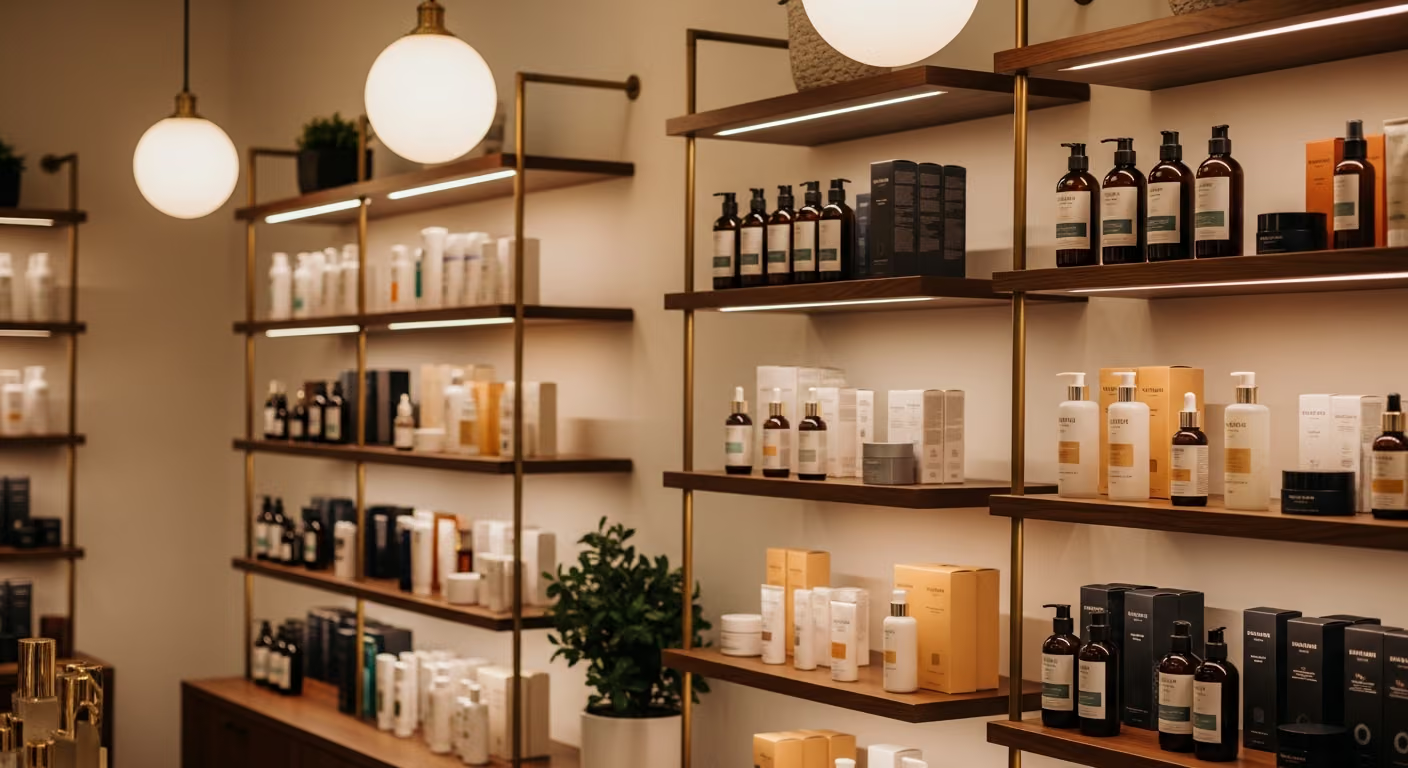
A guest walks out of an aromatherapy facial at 11:43 a.m., loves the cuticle oil the esthetician used on her hands, and buys the bottle on the way out for $42. For the next four to six hours she is at peak buying intent. She is about to text her sister about how good the appointment was. If a follow-up offer for the matching serum lands in her inbox that afternoon, she opens it. If it lands the following Tuesday, she scrolls past.
The standard spa workflow defeats this completely. The sale happens at the front desk. The numbers sit in Mindbody. Someone pulls the weekly sales export on Friday afternoon and loads it into Keap. The upsell goes out the following Monday. By then the guest has had four days to forget the cuticle oil, the smell of the treatment room, and the esthetician’s name.
Here is an illustrative example. Heron’s Rest Day Spa (a hypothetical day spa), a single location with 6 estheticians and a retail-heavy revenue mix, measured this exact gap. Retail follow-up emails sent within 6 hours of purchase converted to a second purchase at roughly 11 percent. The same emails sent 4 days later converted at under 2 percent. By default, they were running the slow version.
This post is about closing the gap between “purchase at the register” and “upsell email lands” to under an hour.
What Your Front Desk Sees Versus What You Can Act On
CRMConnect Mindbody to Keap updates your marketing the instant a sale happens. The moment the front desk rings up that cuticle oil, the guest’s record in Keap reflects it: the item bought, the amount, the date, the treatment that came just before it, an updated lifetime spend, and a tag marking what kind of product she bought.
That happens in seconds. Any follow-up you have set up around retail purchases can act on it immediately. There is no Friday export, no Monday delay. The window is open while the guest is still telling her sister about the appointment.
Building the Retail-to-Service Follow-Up
In Keap, you set up one follow-up sequence that runs whenever a guest buys a retail product.
Two hours after the purchase, a short email goes out under the esthetician’s first name. Subject: “Your facial today + the cuticle oil you grabbed.” Body: a one-paragraph thank-you, then a single curated recommendation for a product that pairs with what she bought. One link, no carousel of options.
On day 7, a “how is the cuticle oil treating you?” check-in, with a quiet booking link for her next facial. The check-in framing matters. It does not read like a sales email, even though it is.
On day 21, if there has been no second purchase or booking, an explicit “the serum that pairs with what you bought” offer with a one-click link.
The reason this works is the timing. Pushing touch one to “next day” loses most of the lift, because the guest has already finished telling her sister about the appointment by then.
Make the Offer Match the Treatment
The most underused move in spa retail is matching the cross-sell to the treatment. A guest who bought cuticle oil after an aromatherapy facial is in a different mood than a guest who bought the same oil after a deep tissue massage. The first is open to a skincare cross-sell. The second is more open to a wellness or recovery cross-sell.
Because Keap knows the treatment that came just before the purchase, you can branch the follow-up:
- After an aromatherapy facial, recommend a matching serum or facial mist.
- After a deep tissue massage, recommend arnica balm or a muscle-recovery oil.
- After a couples massage, recommend his-and-hers travel kits.
- After a hydrating body treatment, recommend a matching body lotion.
Each branch uses the same simple shape (touch one, touch two, touch three), just with different products. The branching adds maybe an hour of setup and lifts conversion noticeably, because the recommendations actually make sense to the guest.
All of this works on day one, because CRMConnect sets up the client details in Keap during setup. The treatment a guest just had is already there, no manual work required.
What This Means for Your Bottom Line
In an illustrative deployment at a spa of this size, the share of services that lead to a same-visit retail purchase stays roughly stable. Fast follow-up does not change that directly. What it changes is the follow-on purchase rate within 30 days of a retail buy, which typically moves from a baseline of 4 to 8 percent up into the 14 to 22 percent range within 60 days.
For Heron’s Rest, with roughly 250 retail purchases a month, that means roughly 25 to 50 extra follow-on retail purchases a month once the campaign goes live. At an average follow-on ticket of $58 (illustrative), that is somewhere around $1,500 to $2,900 in monthly retail revenue, or $18K to $35K a year.
The other win is the relationship. When a guest gets a personal “from Elena” email two hours after the appointment, recommending a product Elena would actually recommend, she feels meaningfully closer to that esthetician. Rebook rate on an esthetician’s clients tends to climb roughly 6 to 10 points over the following quarter.
These numbers are illustrative. Your retail mix and price points drive the actual outcome.
Want to see CRMConnect Mindbody to Keap in action? View the API App page.
Keep reading
The Gap Between "I Paid" and "I'm Booked"
A customer buys a class pack on Shopify, then can't figure out how to book it. Here's how a Mindbody booking widget and ShopConnect close that gap for good.
Mindbody and HighLevel: One Clear Schedule Per Student Across Every Program
If your studio runs beginner programs, longer courses, and private lessons at once, here is how your reminders finally match what each student actually has booked.

Mindbody and Klaviyo: Per-Location Marketing for a 6-Gym Strength Network
A central marketing team sending one blast to every member of a 6-gym network gets the coach name and the gym address wrong half the time.