
Mindbody and Shopify: Launch a Studio Store Without Doubling the Work
How ShopConnect's effortless product sync and real-time inventory sync let a single-location studio launch Shopify without ever touching inventory twice.

Why Most Studios Skip Selling Online
Picture a hypothetical 240-member boutique yoga studio with a small retail nook: mats, blocks, branded tees. The owner wants to put that catalog online. She already has every product, price, and stock count inside Mindbody. What she does not want is a second place to manage it all: a Shopify catalog that drifts away from the studio catalog by lunch on day one.
This is the single biggest reason boutique studios skip ecommerce. The retail side works because front desk staff scan items at checkout and Mindbody updates the stock count. The moment you stand up a separate online store, every sale, return, restock, and price change has to be entered twice. By week two, the two systems disagree, and someone ends up babysitting a spreadsheet.
There is a quieter cost too. The owner spent two years training her front desk to trust the Mindbody catalog. They scan, they check stock, they reorder when the system tells them to. A second catalog erodes that trust the first time a customer asks “do you have this in medium” and staff has to check two screens to find out. She is not just protecting margin, she is protecting the smooth operation she already built.

What the Two-Catalog Problem Really Costs
Plenty of basic tools will happily push a list of products into Shopify on a schedule. That part is easy. The hard part is keeping everything live: stock counts after every sale on either side, sizes and colors, the price change you made at the Mindbody register at 6:45am, the tax that depends on whether the buyer is a member, and the fact that some Mindbody items are services (a class pack) that should never appear on the storefront as a shippable product.
Generic automation tools can pass a basic signal, but they do not understand a Mindbody product catalog the way a Mindbody specialist does. You end up spending two months building a fragile setup that breaks the first time someone adds a new color from the front desk iPad.
There is a deeper problem. Generic tools treat products as flat records. A real Mindbody product is layered: one product with size and color options, each option with its own barcode and its own stock count at each location. Shopify has its own structure. Lining one up with the other is the actual job. Most tools skip it, flatten both sides, and leave you managing sizes and colors by hand, which is the exact thing you were trying to avoid.
How ShopConnect Makes Mindbody the Single Source of Truth
ShopConnect takes the opposite approach. Your Mindbody product catalog is the single source of truth, full stop. You mark an item “Sell Online” inside Mindbody, and ShopConnect publishes it to Shopify, complete with pricing, taxes, description, images, sizes, colors, and the current stock count. Sell that item on either side, and the stock count updates on the other right away. An overnight check catches anything that drifted (a delivery you received into Mindbody, a refund typed at the register) so every morning opens with both systems agreeing.
Images are the small detail that separates a real integration from a demo. Mindbody product images often live in multiple sizes and orientations. ShopConnect pulls every image attached to the Mindbody product, uploads them to Shopify in the order you set, and makes the first one the main product photo. You upload images once, in Mindbody, and the storefront looks right.
Your descriptions travel too. Whatever you write in the Mindbody product description shows up as the Shopify product description, formatted cleanly. Title, vendor, and tags carry over predictably. The Shopify catalog stops being a second system you maintain and becomes a downstream copy of the Mindbody catalog you already keep current.
How It Works in Plain Terms
Getting started is straightforward. You link Mindbody and Shopify in the ShopConnect setup wizard. No developers, no technical tokens to manage. Inside Mindbody, you mark the retail items you want online (the three locker-room essentials you do not want sold online simply stay unmarked). ShopConnect publishes the rest to Shopify with images, sizes, colors, and live stock counts.
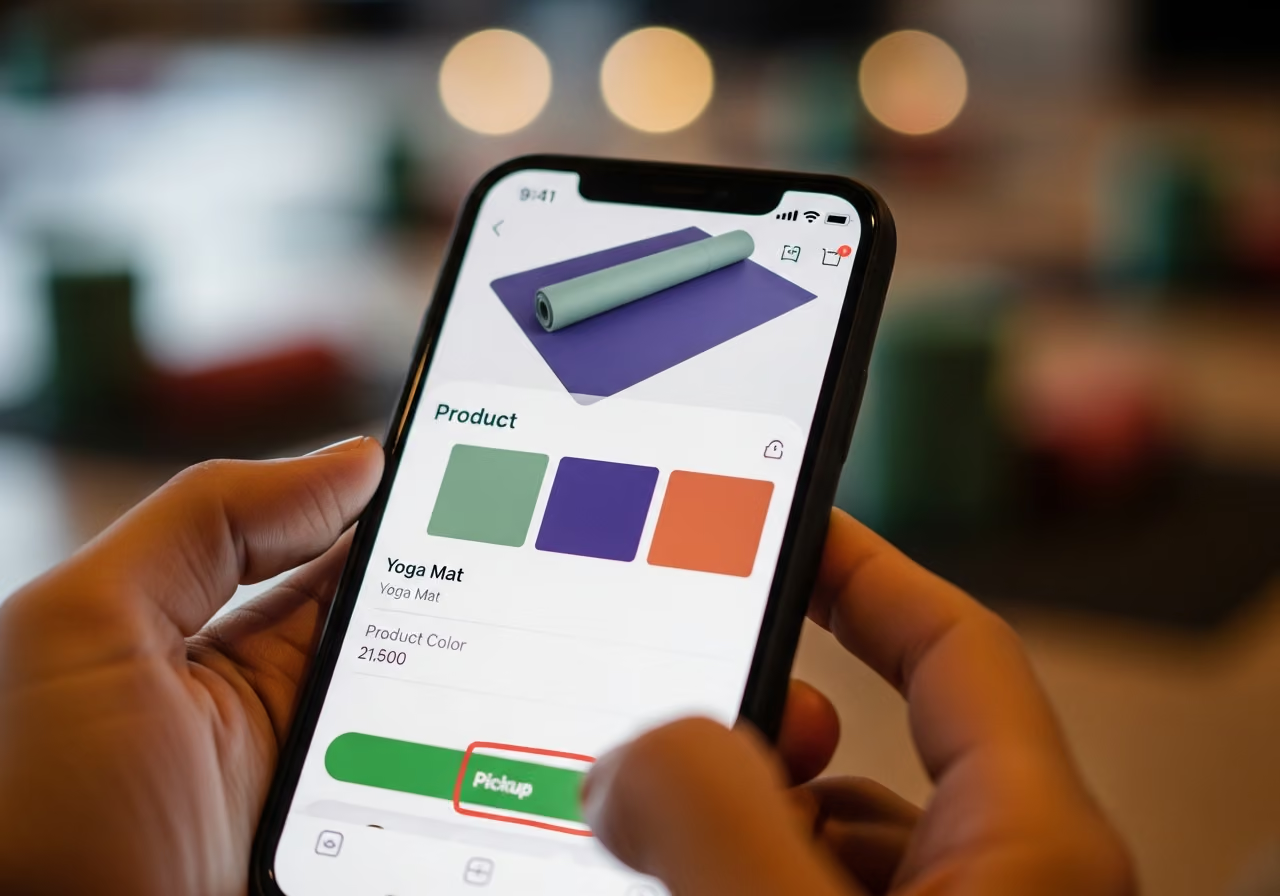
From then on, every Shopify sale lowers the count in Mindbody, and every front desk sale lowers the count online. The overnight check catches restocks you do by hand after a delivery. You can also offer pickup at the studio or shipping to home, which avoids shipping cost on the heavier items. You never touch the Shopify product list again. You manage the catalog where you always have, inside Mindbody.
For the first week, it is worth watching the ShopConnect activity log. You will see every product publish and every stock update, so anything unexpected (a product that did not publish, a size that mapped oddly) shows up there, not in a customer complaint two weeks later.
Representative Retail Lift at 240 Members
Here is an illustrative picture for a single-location studio at 240 members with this setup. Retail revenue lifts in the range of 18 to 32 percent within the first quarter, almost entirely from members buying between classes and from gift purchases that would never have walked through the door. Staff time on inventory reconciliation drops to essentially zero, because the overnight check handles it. Overselling stays under one percent, and the few that slip through get caught quickly because stock counts update on every sale.
There is a second benefit worth naming. Once you trust the integration, you start using Shopify sales data to decide what to stock. The best-selling tee colors online become the colors you reorder for the studio. The slow movers online signal what to clear at the studio too. Your inventory decisions get smarter because you finally have data you did not have when retail was studio-only.
Why This Matters for Your Studio
Pick your single source of truth before you pick a tool. If Mindbody runs your business, Mindbody should run your catalog. Live stock updates plus an overnight check is the simple, correct pattern. The hard part of putting your studio online is not pushing products to Shopify, it is handling sizes, services versus products, tax, and location correctly. A turnkey solution is worth far more than a month of building.
Want to see ShopConnect for Mindbody and Shopify in action? View the API App page.
Keep reading

The Gap Between "I Paid" and "I'm Booked"
A customer buys a class pack on Shopify, then can't figure out how to book it. Here's how a Mindbody booking widget and ShopConnect close that gap for good.

Mindbody and HighLevel: One Clear Schedule Per Student Across Every Program
If your studio runs beginner programs, longer courses, and private lessons at once, here is how your reminders finally match what each student actually has booked.

Mindbody and Klaviyo: Per-Location Marketing for a 6-Gym Strength Network
A central marketing team sending one blast to every member of a 6-gym network gets the coach name and the gym address wrong half the time.