
Mindbody and Zapier: A Live View of Every Site and Membership
Use AppConnect's location management and membership management triggers to stream Mindbody site and membership data into a central ops stack through Zapier.

The Central-Team Visibility Problem
Picture an illustrative franchise wellness brand running 23 Mindbody sites under a central operations team. The central toolset includes a CRM, an email platform, a business intelligence tool, and a customer support tool. All four need a current view of memberships and site information across all 23 locations.
Today, the operations team runs weekly spreadsheet exports from each Mindbody site, merges them together, and re-imports into each tool. The data is a week stale by the time it lands. Marketing campaigns fire at lapsed members. Support tickets get routed to the wrong location.
There is a member-experience version of this problem too. A member who calls support about a billing issue at one site reaches an agent looking at week-old data. The agent does not know her current membership status, her current location, or her current contract state. The call takes twice as long and she ends it more frustrated than she started. Multiply that by hundreds of support tickets a week and the franchise’s customer satisfaction takes a hit.

What the Weekly Export Ritual Costs
Most basic integrations work one site at a time. A 23-site franchise needs a single, current feed across all sites, with the location attached so every downstream tool can filter and route correctly.
Homegrown scripts can produce that feed but need constant maintenance. Every change in Mindbody, every new site, every change in a downstream tool is another thing to fix. Most franchises end up running the script only weekly because nobody trusts it enough to run it more often.
Per-site integration sprawl is operational debt that piles up quietly. Each site with its own connection to its own marketing tool, its own support tool, its own BI tool, is a separate point of failure. A 23-site franchise running per-site integrations is really running 23 separate setups. When something breaks, nobody knows where, and nobody can fix it without digging into a site-specific configuration.
How AppConnect Gives You One Live Feed
AppConnect manages all 23 sites under one subscription. It delivers current site information (new sites, renamed sites, deactivated sites) and current membership status changes (active, paused, cancelled, expired) to your central toolset, with the location attached to every update.
From there, updates flow into your CRM, email platform, BI tool, and support tool. The operations team gets a single, current view across the franchise. Campaigns target current members. Support tickets route to the right site automatically.
The single-subscription model collapses the sprawl. One subscription handles all 23 sites. One configuration handles all the routing. When the franchise adds Site 24, the operations team adds it to AppConnect and the data starts flowing to every tool automatically. No new accounts, no per-site setup, no rebuilding the whole stack.
It also absorbs change for you. As your downstream tools evolve (your CRM adds a field, your email platform restructures its lists), the integration layer handles that change once and applies it across all 23 sites. Your operations team maintains one consistent setup, not 23 drifting copies.
How It Works in Plain Terms
You turn on the location and membership connectors, and one subscription covers all 23 sites. Updates fan out automatically to your CRM, email platform, BI tool, and support tool. For each tool, you set up the location field so segments, campaigns, and routing rules can filter correctly.
You run one backfill at the start to establish a clean baseline, and from that point everything runs current. The weekly spreadsheet ritual ends.
Two things are worth doing carefully. First, agree on naming conventions across tools. A site called “Downtown Wellness Center” in one tool, “DWC” in another, and “Downtown” in a third is a support nightmare, so the canonical name propagates from the integration layer. Second, sequence that initial backfill so each tool’s limits are respected; AppConnect paces the backfill and runs current from the cut-over point.
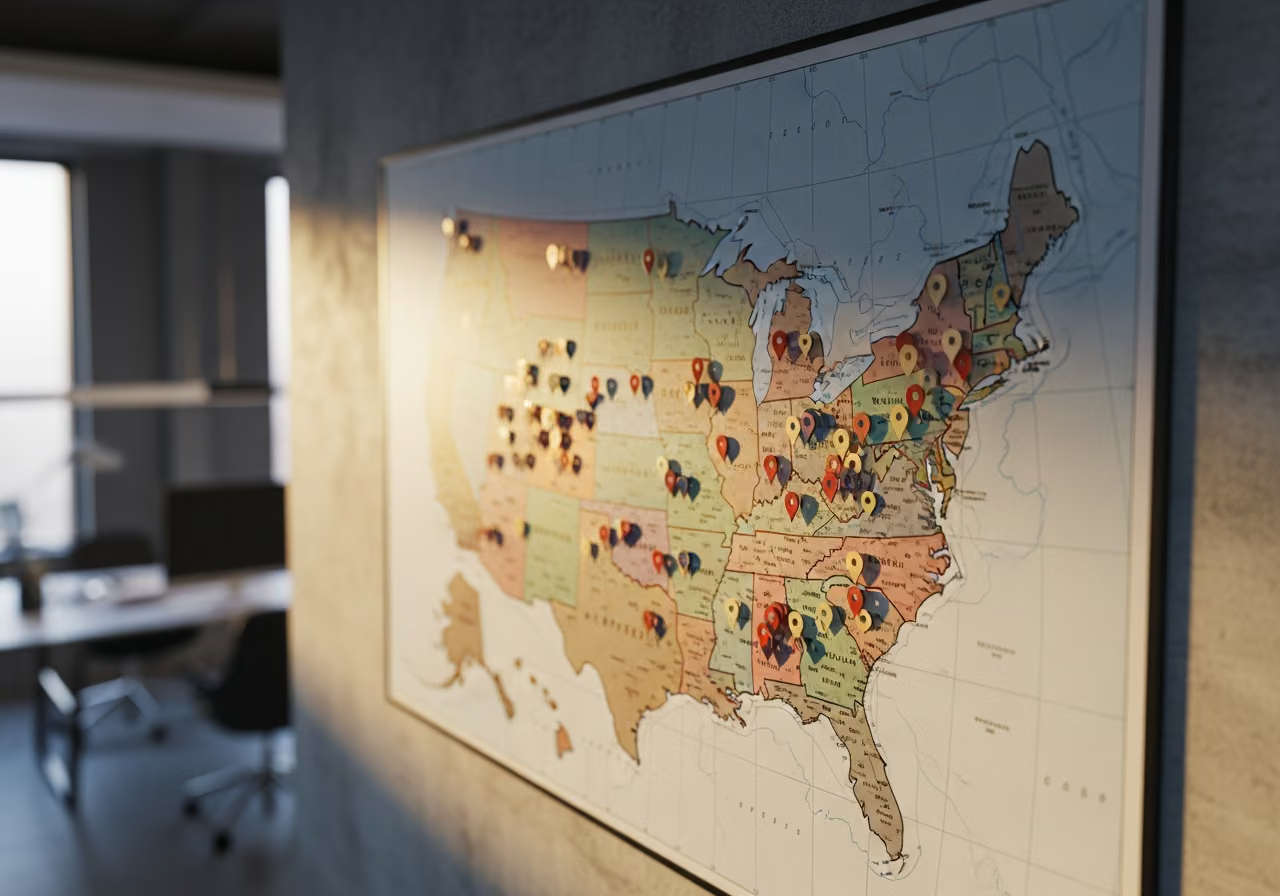
Representative Operations Efficiency at 23 Sites
Here is a hypothetical example. A 23-site wellness franchise with about 16,000 active memberships turns on real-time site and membership sync through AppConnect. Operations team time on the weekly export-merge-import routine drops from approximately 12 hours a week to zero. Email campaigns sent to lapsed members in error because of stale data drop to zero. Support ticket mis-routing drops from roughly 8 percent to under 1 percent.
Strategic clarity improves at the executive level. The franchise leadership sees a single view of membership growth across all 23 sites, current. Site-by-site comparisons are apples to apples. Decisions about which sites to invest in, which to consolidate, and where to open next are based on clean, current, comparable data. The integration becomes a strategic asset, not just a tactical convenience.
Why This Matters for Your Bottom Line
A multi-site franchise needs current data, not weekly data. The cost of stale data shows up in every tool you run. One subscription, every site, one feed. Per-site integration sprawl is operational debt you pay for forever. And tagging every record with its location at the integration layer is the foundation for every campaign, every segment, and every routing rule downstream.
Want to see AppConnect for Mindbody and Zapier in action? View the API App page.
Keep reading

The Gap Between "I Paid" and "I'm Booked"
A customer buys a class pack on Shopify, then can't figure out how to book it. Here's how a Mindbody booking widget and ShopConnect close that gap for good.

Mindbody and HighLevel: One Clear Schedule Per Student Across Every Program
If your studio runs beginner programs, longer courses, and private lessons at once, here is how your reminders finally match what each student actually has booked.

Mindbody and Klaviyo: Per-Location Marketing for a 6-Gym Strength Network
A central marketing team sending one blast to every member of a 6-gym network gets the coach name and the gym address wrong half the time.