
Mindbody and Zapier: Turn Meta Ad Leads Into Clients in Minutes
Use AppConnect's Zapier-to-Mindbody automations to add or update Mindbody client profiles from Meta lead ads and seamlessly enroll them into intro classes.

Why Speed Decides Whether a Lead Converts
Picture an illustrative wellness brand running paid Facebook and Instagram lead-form ads to grow trial-class signups. The lead form fires on the social platform. The brand wants the lead to land as a Mindbody client within minutes, get an automated welcome text, and show up in the studio manager’s call list for a personal follow-up the same day.
The default process is broken. Those leads end up in a spreadsheet that the marketing manager exports daily, emails to the studio manager, and gets typed into Mindbody by hand. The fastest the lead reaches Mindbody is the next morning. By then, the lead has gone cold or signed up with the studio down the street.
There is an attribution problem the brand may not even know it has. Without fast, structured client creation, the marketing team cannot tie ad spend to actual paying clients. The ad dashboard shows leads. Mindbody shows clients. Connecting the two requires a clean handoff that tags each new Mindbody client with the ad and campaign that produced them. Without that, the brand cannot calculate its true cost per client by campaign and is flying blind on where to spend.
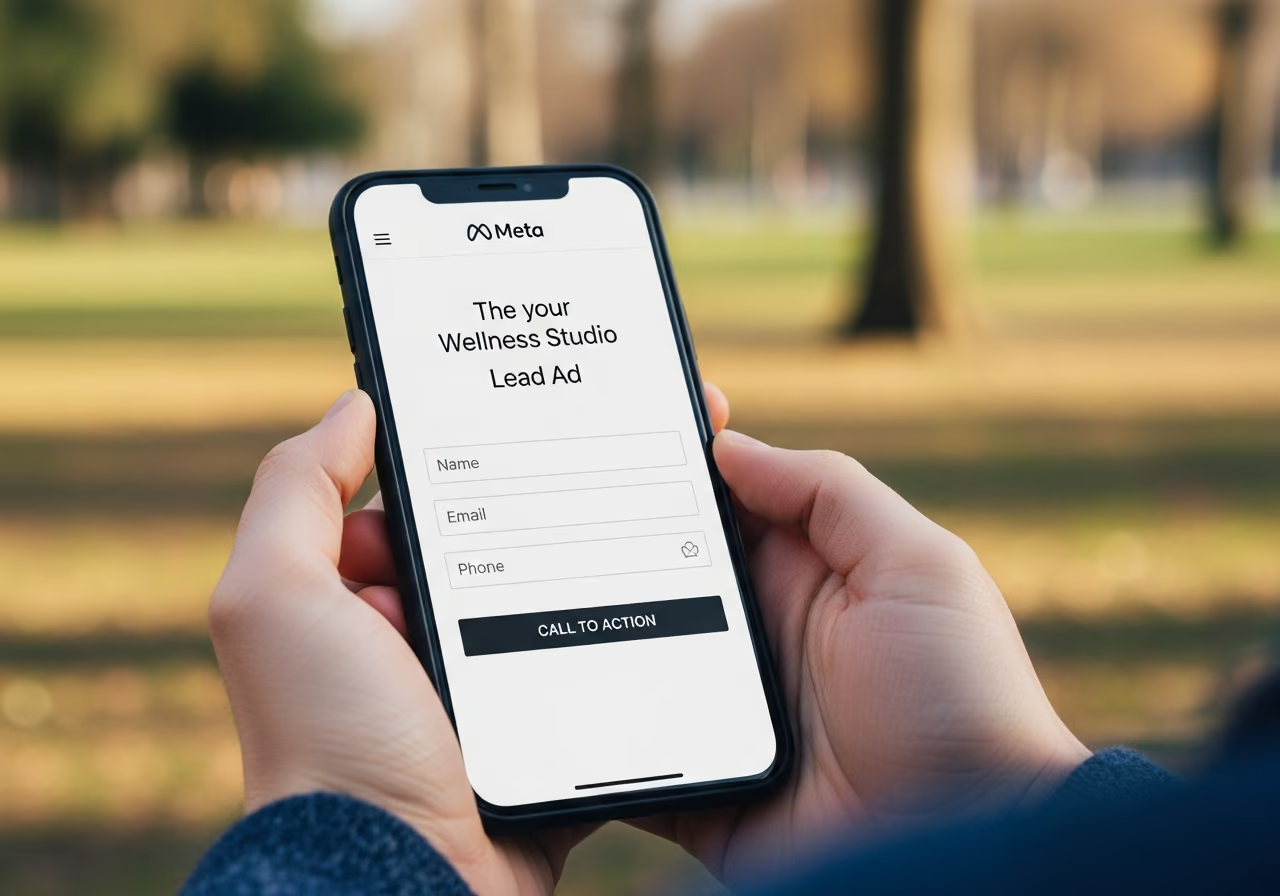
What the Spreadsheet Handoff Costs You
The basic Mindbody connectors cannot reliably create clients across the messy reality of real lead funnels: spotting duplicates by email, partial data from a lead form, the right custom fields, the right location, and the right tags for your marketing follow-up. They simply do not go deep enough for what your operation needs.
Timing is the killer. A lead submits the ad form, gets the welcome text, clicks the booking link, and tries to book a trial class. If her Mindbody client profile has not been created yet, the booking fails because Mindbody does not know who she is. She bails. Getting the lead into Mindbody in under a minute is not a vanity number, it is the floor for a working trial-class funnel from paid ads.
How AppConnect Lands Leads in Seconds
AppConnect’s inbound automations handle exactly this. The lead lands from the social platform, and AppConnect adds or updates the Mindbody client. It handles duplicate detection, assigns the right location, fills in the custom fields, and applies your tags.
In the same flow, the welcome text goes out, the lead gets pushed into your CRM, and a follow-up task gets created for the studio manager. The lead reaches Mindbody in seconds, not the next morning.
Mapping the fields from a paid-social lead form is its own art. The form might ask for name, email, phone, city, and a custom question about goals. AppConnect maps each field to the right place in Mindbody (name and email to standard fields, goals to a custom client field, city to help assign the right location for a multi-site brand). You get a structured client profile instead of a blob of form data dumped into the notes.
Tagging the source at creation closes the attribution loop. Every Mindbody client created through the ad funnel gets a tag identifying the campaign and ad set. Your BI tool can then join Mindbody attendance and sales with ad spend on that tag, and your true cost per client by campaign becomes a live dashboard instead of a quarterly spreadsheet exercise.
How It Works in Plain Terms
You connect your Facebook and Instagram lead form to AppConnect. When a lead comes in, AppConnect creates or updates the Mindbody client, mapping name, email, phone, location, and any custom fields from the form. In the same flow, a welcome text goes out with a class booking link, the lead is pushed into your marketing list, and the studio manager gets a notification.
You test it with a real lead submission, confirming the client lands in Mindbody within a minute, the text arrives, and the manager is notified.
Two refinements are worth setting up. First, a duplicate rule: some leads are existing clients filling out the form for an offer, so matching by email (or phone) prevents a duplicate record while the existing client still gets the tag and the follow-up. Second, quiet hours: a lead submitting at 11pm gets the welcome text the next morning, not in the middle of the night.

Representative Lead-to-Visit Rate at 360 Members
Here is a hypothetical example. A wellness brand spends about $12,000 a month on Facebook and Instagram lead-form ads, generating roughly 800 leads a month. Before AppConnect, the time from lead to Mindbody client averaged about 18 hours. After, it is under 90 seconds. Trial-to-paid conversion lifts from roughly 22 percent to roughly 31 percent, almost entirely because the first contact reaches the lead while she is still warm. Marketing manager time on lead handling drops from about 5 hours a week to zero.
The compounding effect is what makes paid social actually worth running. With under-a-minute lead handling, source tagging, and clean attribution, the marketing team can test ad creative weekly with real conversion feedback. Campaigns that work get scaled. Campaigns that do not get cut. Spend efficiency improves quarter over quarter instead of stalling because nobody can measure it.
Why This Matters for Your Bottom Line
The speed from lead to client is the variable that drives the return on your paid social budget. Compress it. Bringing leads in is not the same as pushing your clients out, so getting the duplicate detection and field mapping right matters or you will slowly corrupt your client list. And one workflow that creates the client, sends the text, updates the CRM, and creates the task beats a chain of disconnected tools. One lead, one workflow.
Want to see AppConnect for Mindbody and Zapier in action? View the API App page.
Keep reading

The Gap Between "I Paid" and "I'm Booked"
A customer buys a class pack on Shopify, then can't figure out how to book it. Here's how a Mindbody booking widget and ShopConnect close that gap for good.

Mindbody and HighLevel: One Clear Schedule Per Student Across Every Program
If your studio runs beginner programs, longer courses, and private lessons at once, here is how your reminders finally match what each student actually has booked.

Mindbody and Klaviyo: Per-Location Marketing for a 6-Gym Strength Network
A central marketing team sending one blast to every member of a 6-gym network gets the coach name and the gym address wrong half the time.