
Mindbody and Zoho CRM: Catch Failed Auto-Pays the Same Day

Why End-of-Month Contract Reports Cost You Members
Contract memberships look like predictable revenue right up until an auto-pay fails. The window after that failure is short. It takes roughly 24 to 72 hours for a member with a declined card to start quietly looking at the studio down the road. Most studios run a contract status report on the first of every month, which means a payment that failed on the third sits in the dark for 27 days. By the time anyone sees it, the member has already moved on.
Consider an illustrative example. Mirror Lake Pilates (a hypothetical single-location studio) has 360 contract members. The front desk and sales team run everything through Zoho CRM, except contract details, which live in Mindbody. Month-end reconciliation eats half a day. Auto-pay failures get noticed around day 28, recovered maybe a third of the time, and the rest churn. Nobody is doing anything wrong. The information just arrives too late to act on.
What the Manual Process Actually Costs
When contract and payment information lives in one system and your member relationships live in another, someone has to bridge the gap by hand. That usually means a manager pulling reports, cross-checking PDFs, and updating spreadsheets at month end.
The real cost is not the half day of admin. It is everything that happens in the 27 days before anyone looks. A member whose card expired never got a heads up. A member with a one-time insufficient funds problem never got a friendly nudge. By month end, the relationship has cooled and the recovery conversation is awkward instead of routine.
How It Works Once Contracts Flow Into Zoho CRM
CRMConnect Mindbody to Zoho CRM keeps live contract and auto-pay information sitting right inside the CRM your team already uses. Contract details, the auto-pay status, the next charge date, the amount, and renewal dates all stay current automatically. Nobody re-keys anything, and nobody waits for a report.
What your front desk and managers see:
- Every member record shows whether their auto-pay is healthy, retrying, or failed, updated as soon as it changes.
- Contract names, start and end dates, and monthly amounts are visible without opening Mindbody.
- The moment a payment fails, that member surfaces in a list your team can act on today.
The practical shift is simple. Instead of discovering failed payments at month end, you see them within hours.

Turning a Failed Payment Into a Same-Day Recovery
Once the auto-pay status is live in Zoho CRM, you can build a calm, automatic recovery sequence around it. A workable version looks like this:
- As soon as a payment is flagged as failed, the member gets a friendly text the same hour: “Our system flagged that your payment did not go through. You can update your card here. Reply if you need a hand.”
- Four hours later, if the card still has not been updated, the membership specialist gets a task with full context: last successful payment, amount owed, how many retries.
- The next day, a short email goes out from the studio owner offering a quick call.
- After two days unresolved, an owner call task is created for that day.
- If the member updates their card at any point, the remaining steps stop and a confirmation text goes out.
- If five days pass with no resolution, the member is flagged at risk and an in-person retention conversation gets scheduled.
The same-day text recovers most of the volume on its own. Failed cards are usually expired cards or a temporary funds issue the member did not even know about. Catching the failure within hours instead of weeks is the single biggest factor in whether you keep that member.
Renewal Dates Become a Revenue Forecast
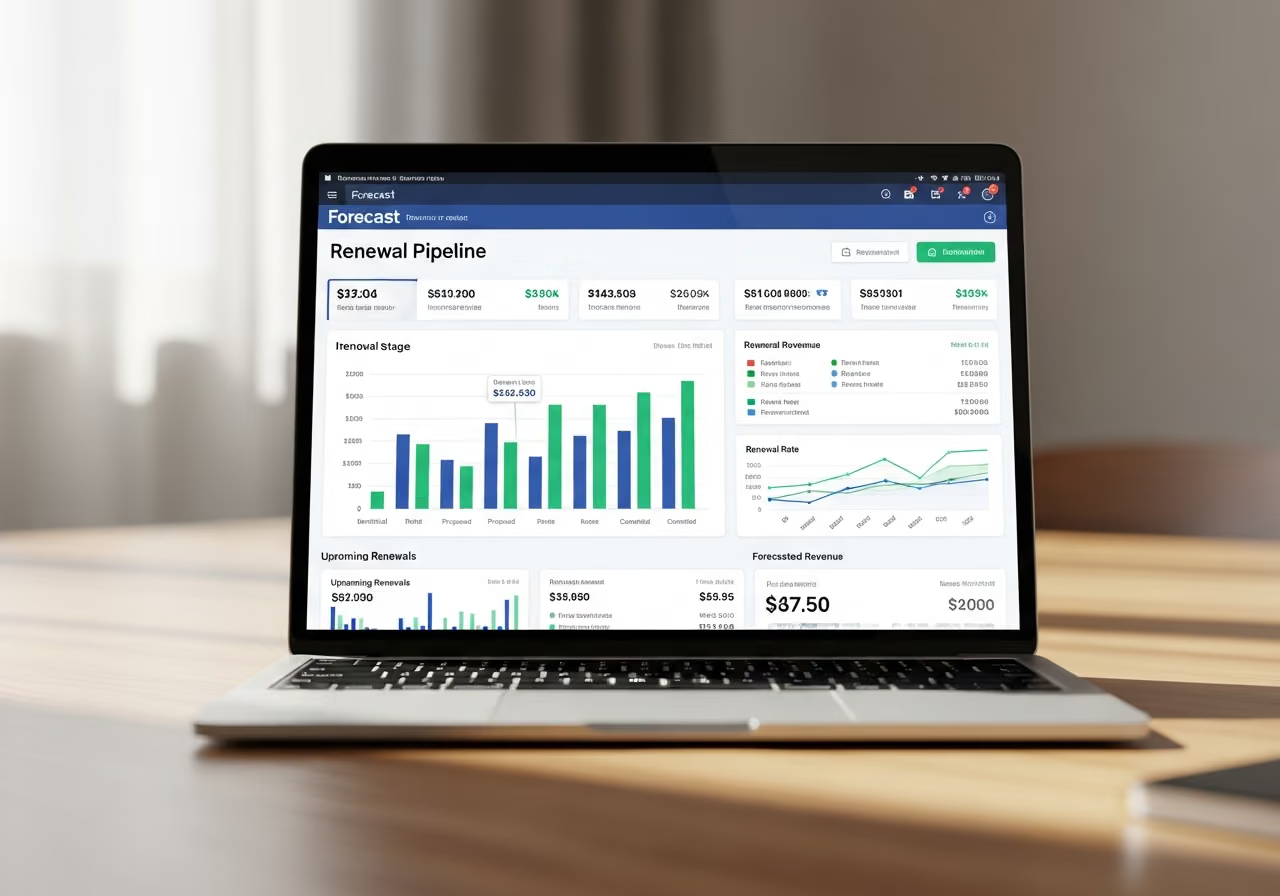
The same live connection puts every contract’s end date in front of your sales team, which turns renewals into something you can plan around instead of react to.
- A 90-day forward view: add up the monthly value of every contract ending in the next three months to see renewal revenue before it is at stake.
- A renewal call queue: contracts ending within 45 days, sorted so your highest-value members get a personal conversation first.
- Staffing clarity: separate the contracts that renew automatically from the ones that need a manual touch, and plan your team’s time accordingly.
The forecast is only trustworthy because the underlying numbers are current. Month-end reports get renewal forecasts wrong by 5 to 15 percent simply because the inputs are stale.
What the Numbers Could Look Like
These figures are illustrative composites, not a real customer, but they show the shape of the change at a studio of roughly 360 contract members:
- Recovery rate when failures are caught at month end: roughly 25 to 35 percent.
- Recovery rate with a same-day text and a next-day owner email: a lift into the 60 to 75 percent range.
- Revenue saved each quarter from earlier detection: a meaningful share of the contract base, depending on average contract size.
- Owner time on contract reconciliation: down from around 4 hours a month to under 1, with that hour now spent on the members who genuinely need attention.
The mechanism is not clever marketing. It is fast detection plus a sequence the member can actually respond to. The integration handles the detection. Your sequence just has to be honest and easy to act on.
Why This Matters for Your Bottom Line
- Treat failed auto-pays as a same-day event, not a month-end discovery. The speed of your response is most of the recovery rate.
- A friendly, low-pressure first message wins back members who simply had an expired card.
- Contract end dates are the most reliable forward-looking revenue number a studio has. Use them to plan, not just to report.
Try It in Your Studio
Curious how this works on your member data? View the API App page.
Keep reading

The Gap Between "I Paid" and "I'm Booked"
A customer buys a class pack on Shopify, then can't figure out how to book it. Here's how a Mindbody booking widget and ShopConnect close that gap for good.

Mindbody and HighLevel: One Clear Schedule Per Student Across Every Program
If your studio runs beginner programs, longer courses, and private lessons at once, here is how your reminders finally match what each student actually has booked.

Mindbody and Klaviyo: Per-Location Marketing for a 6-Gym Strength Network
A central marketing team sending one blast to every member of a 6-gym network gets the coach name and the gym address wrong half the time.