
The Feature We Avoided for Years, Built in Days
How ShopConnect learned to sell a booking, and what it taught us about building with an AI operator on an AI-first platform
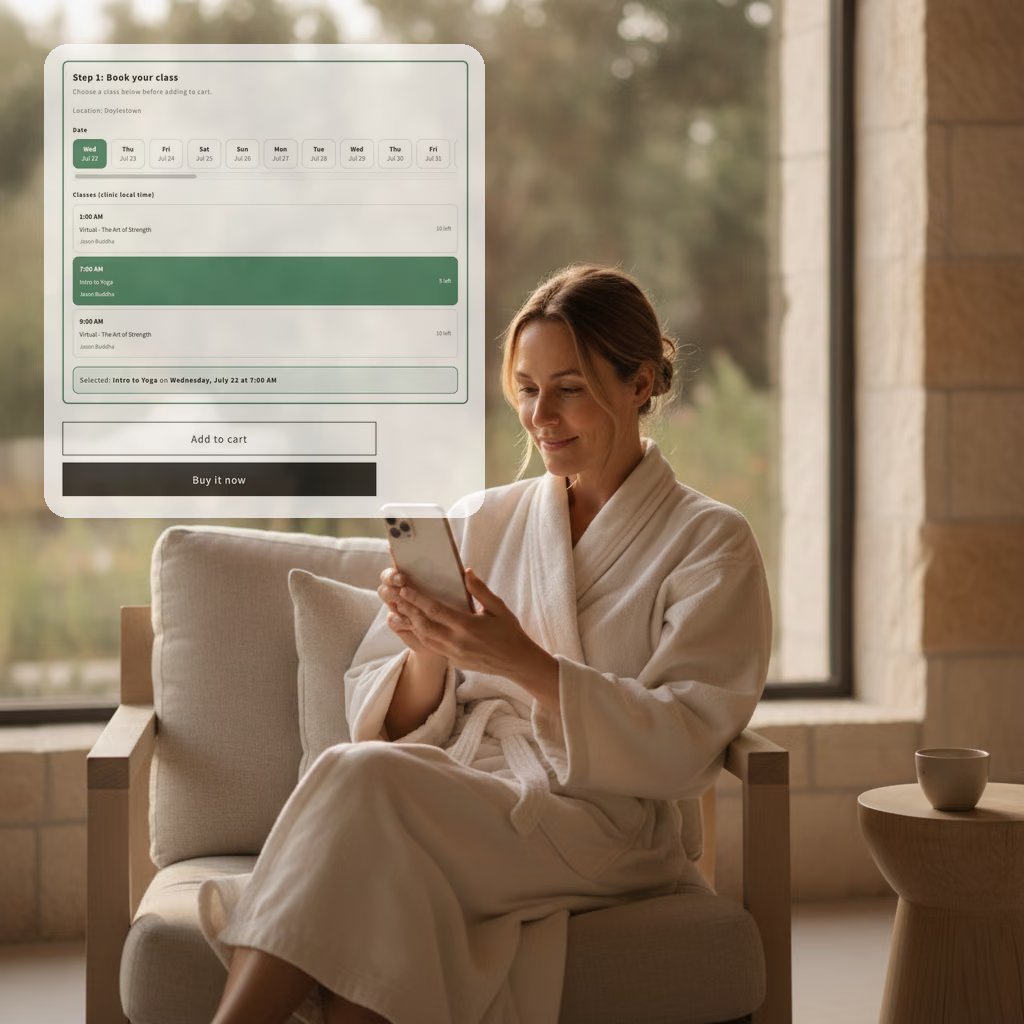
How ShopConnect learned to sell a booking, and what it taught us about building with an AI operator on an AI-first platform.
For as long as we have packaged integrations as turnkey products, one request has come back more than any other. Let a shopper book a Mindbody appointment or class at the moment they buy it on a Shopify store, against real availability. We heard it for years. We never built it.
We were honest about why. The idea was small to describe and enormous to deliver. Pull live openings from a scheduling system that might span several locations. Route each booking to the right place. Do all of it inside someone else’s storefront, in their cart, and make it reliable enough to sell. Every time we looked at it, the complexity looked back. So it stayed on the “someday, maybe” list, the polite place where good ideas go to wait.
Then we built it in a few days. Conceived, planned, built, tested, and made ready to deploy as an option, in less time than we used to spend scoping the thing. This is the story of how, and why it could only have happened now.
The years-long wish
Ask anyone who sells services online what they want from their store, and you arrive at the same place. They want the sale and the booking to be one motion. Buy the massage and pick the time. Buy the class pack and grab a seat. One flow, no gap, no follow-up email that half of people ignore. That is the wish. It is obvious. It is also why it sat unbuilt, because obvious and easy are not the same word.
Why we never built it
The hard part was never the button. It was everything behind the button.
Availability has to be real and live, because nothing burns trust faster than offering a time that is already gone. A single business might run more than one location, each with its own schedule, and the store has to know which one a shopper is looking at. The booking has to land in the right place after payment, every time, without a human babysitting it. And all of it has to live gracefully inside a storefront we do not own, next to products that have nothing to do with booking, without touching a checkout that already works.
Any one of those is manageable. Together they form the kind of project that eats a quarter and still feels fragile at the end. We respected that enough to keep saying not yet.
 Two worlds, one motion: the workout floor and the storefront, finally joined.
What changed
What changed was not our appetite for the problem. It was how the problem gets solved.
We now build on an AI-first integration architecture, and the difference is not a faster version of the old way. It is a different way. The platform, the connectors, the runtime that carries each request, the machinery for many accounts and many locations, the reusable building blocks, the deploy pipeline, the ability to run a real execution and watch what happens: all of it is designed to be operated, not just used. The operator is Claude Code.
That pairing is the whole story, so we will say it plainly. This is not something an AI coding tool could have produced on its own. An AI writing code in a vacuum would have hit the same wall we did, only faster. What made this possible is an AI operating an ecosystem purpose-built to be operated by AI. Claude Code did not invent booking from first principles. It composed pieces that already existed, wired the flow between them, ran real bookings to see them succeed, corrected what did not, deployed the same solution across accounts, and confirmed the result in a live store. The building blocks were APIANT’s. The judgment and the hands were the AI’s. Neither half could have done this alone.
The build, in days
It did not begin with a spec. It began with a sales call. A new customer, potentially one of the largest we have taken on, told us plainly that live booking inside their store was the capability they needed. So we did the obvious thing: we fed the transcript of that call straight to the AI and let it work from what the customer had actually said.
From there it moved fast, the way real building actually feels. The system could connect the dots because it is intimate with Shopify, with Mindbody, and with our intent. It built for scale from the very first pass: one location or a hundred networked locations work the same way, one session type or a dozen work the same way, and 1:1 appointments and group classes run through the same scheduling widget. Most of all, it collapsed the cumbersome path that so many Mindbody businesses put buyers through. No creating an account, no verifying an email, no buying in one place and then logging in somewhere else to finally schedule. The purchase and the booking now happen together, in a single transaction that takes less than a minute.
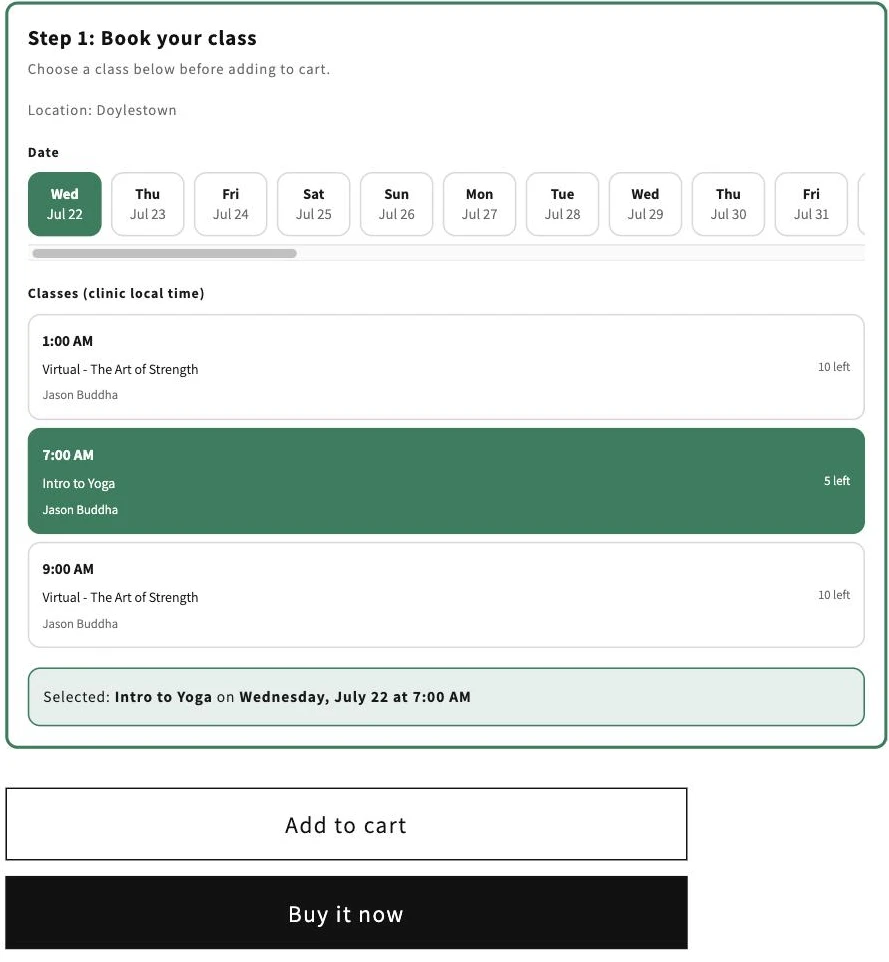 Live on a Shopify product page: pick a location, a day, and a real open class, then check out. The purchase and the booking are one step.
Days, not quarters. The thing we avoided for years was ready to ship in a week.
When the tools did not exist, it built them
Here is the part that still gives us pause. The system did not merely wire together pieces that were already lying around. It hit a wall the platform had never crossed: reading and writing the Shopify storefront theme itself. Most efforts stall right there. This one went and read the relevant Shopify documentation and built the missing capabilities as brand new connector actions, right inside the platform. An action to list the store’s themes. An action to upload the widget’s script to the theme. An action to upload the booking snippet. An action to fetch and rewrite the product template.
None of these were throwaway scripts. Each one became a first-class, reusable building block that any future automation can now pick up and use, no rediscovery required. That is a defining move of AI First: the AI extends the platform’s own vocabulary on demand, and every extension compounds for the next build. A coding tool writes code that lives once. An AI operator on an AI-first platform grows the platform.
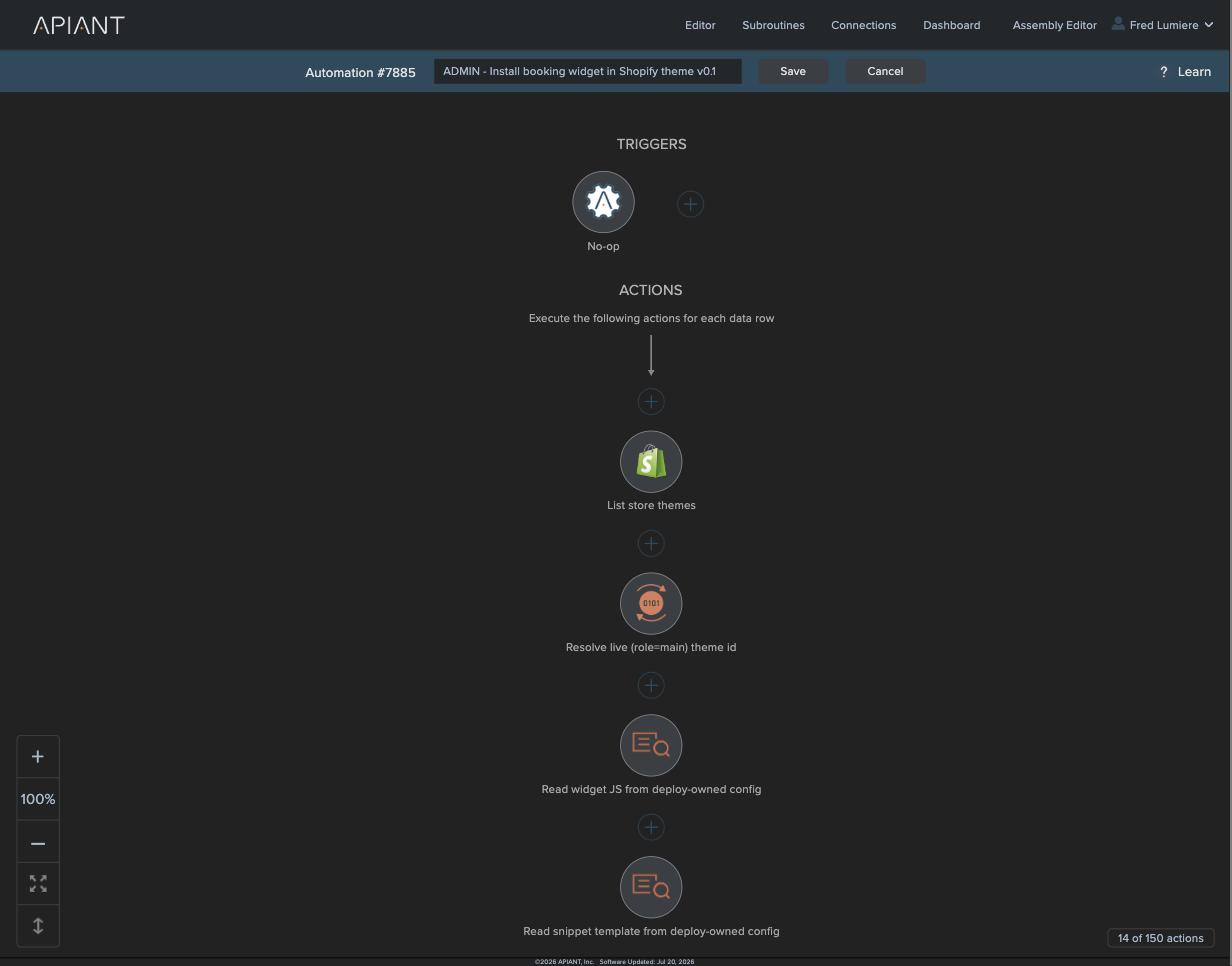 Part of the install flow the system assembled. Each circle is a reusable action it built or composed, including a Shopify “List store themes” action, running in order.
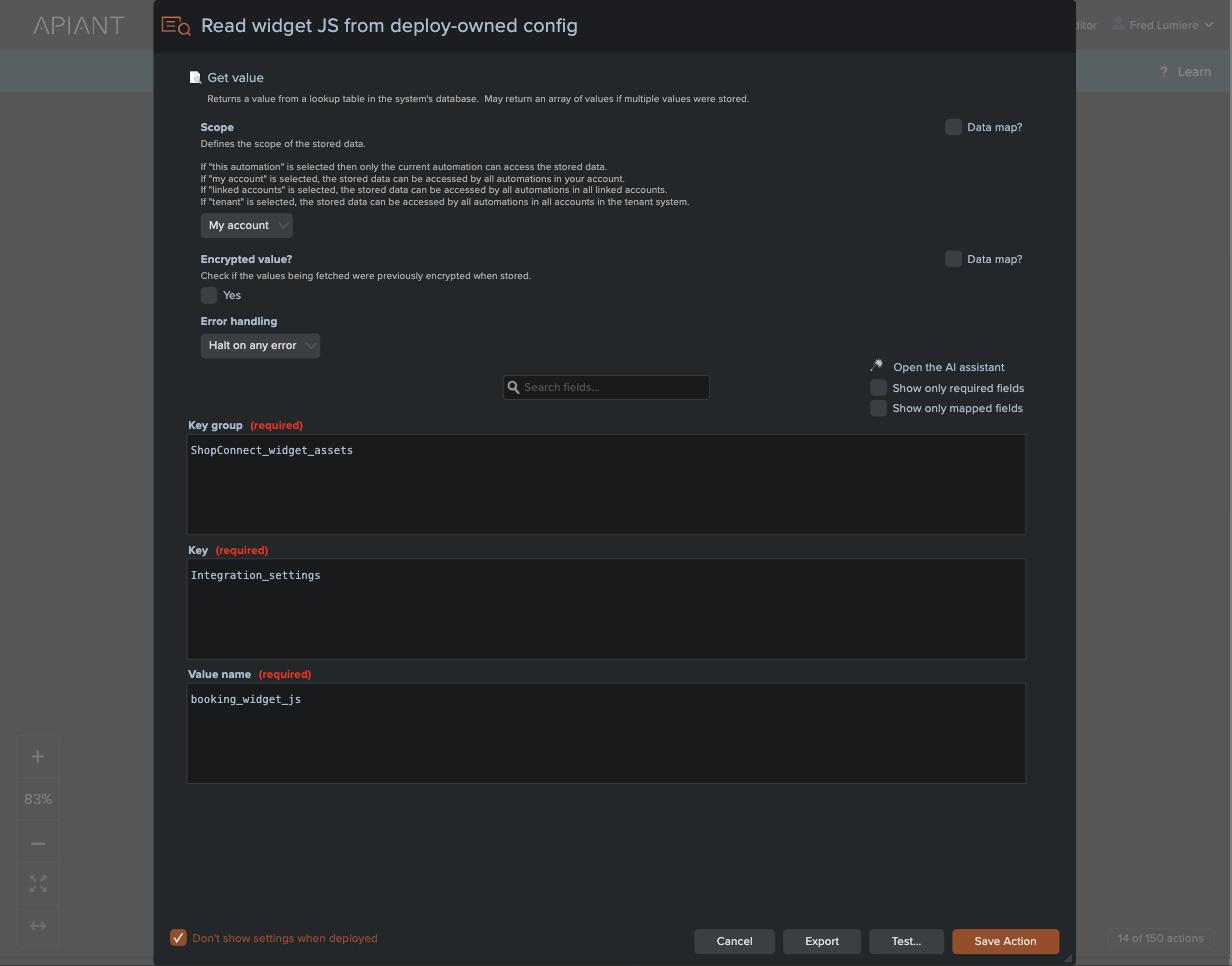 Every new action is a real, configurable building block. Here one action’s settings panel, ready to be reused in any future automation.
How it works, at a glance
The magic is in the experience, not the wiring. A central account orchestrates everything and hands each request to the right location behind the scenes. The storefront reads a small amount of structured information about each product to know what is bookable and what is just a normal thing to buy. Availability is pulled live and shown as real, choosable times, or as real classes with real seats. The shopper picks, pays, and the booking is placed automatically. Multiple locations, one storefront, one cart.
 The moment that used to happen in a follow-up email now happens in the cart.
Why only an AI operator on an AI-first platform could do this
Step back and notice what actually happened. No single leap here was superhuman. The leap was in the number of different kinds of work that had to happen together, fluently, in a short window. Understanding a real-world symptom. Reasoning about a multi-location architecture. Composing existing connectors instead of writing everything fresh. Running live executions and reading the results. Fixing a deep bug without losing the thread. Deploying across many accounts. Verifying in a real store. Writing the documentation.
That is not coding. That is operating. And it only works when the thing being operated was built to be operated, so that every one of those moves is something the platform already knows how to do and the AI can direct. Take away the AI-first platform and you have a clever assistant staring at a wall. Take away the AI operator and you have a powerful platform waiting for someone with a quarter to spare. Put them together and a five-year “someday” becomes a Tuesday.
What it means for builders
 The same booking widget, live on a tablet: pick a real class time and buy it now, in one flow.
If you build integrations, here is the part worth sitting with. The ceiling on what you can ship just moved, and not by a percentage. The projects you have been quietly avoiding, the ones whose complexity you can feel in your chest before you have written a line, are exactly the projects this pairing is good at. Not because the problems got smaller. Because the distance between “we should” and “it is live” collapsed.
We spent years respecting a problem. We now respect it in a different way. We build it.
Availability
Live availability booking is now part of ShopConnect, our turnkey Mindbody and Shopify integration, and it is available to customers as an option today. A shopper can book an appointment or a class against real openings, across multiple locations, from a single Shopify storefront, and pay before they book. If that is the flow you have been wanting, we would love to switch it on for you.
Keep reading

We Gave an AI a Support Ticket. It Rebuilt the Integration and Closed the Loop.
A customer paid $8,400 but the CRM showed $400. We handed the bug to an AI on APIANT and let it diagnose, rebuild, and test the fix end to end.
The "Bug" That Wasn't: How AI Found the Needle in the Haystack and Cleared Our Integration in Minutes
A high-value customer was certain our integration had scrambled their data and asked us to switch it off. With AI wired into every layer of the platform, we traced one record's full history and proved the change came from an upstream third-party app, with evidence, in minutes.

AI-First Integration Engineering With Claude Code: A Real Debug Session
A real APIANT debugging session, with the actual prompts. Watch an AI read a sibling integration and four years of version history, and watch a builder's hunch stop a regression the codebase never recorded.