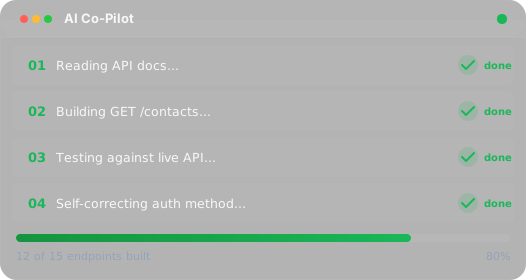
APIANT runs AI at two layers. Claude Code operates the whole platform end-to-end through the APIANT plugin. Inside the platform, the AI you build with: an AI Co-Pilot that builds connectors, autonomous AI Agents, and AI Chatbots.
The first of its kind. The Co-Pilot reads API documentation, builds connectors, tests them against live APIs, and self-corrects. Type an app name, and watch production-ready connectors appear.
Instead of manually reading API documentation and constructing each operation by hand, the Co-Pilot does the heavy lifting.
You can literally let it run overnight and wake up to new ingredients: individual API operations ready to be combined into recipes in the Automation Editor.
Learn more on the Platform pageWhile others treat AI agents as isolated tools, APIANT agents operate inside the full integration platform. Goals, tools, 500+ connectors, and the complete automation engine, all at their disposal.
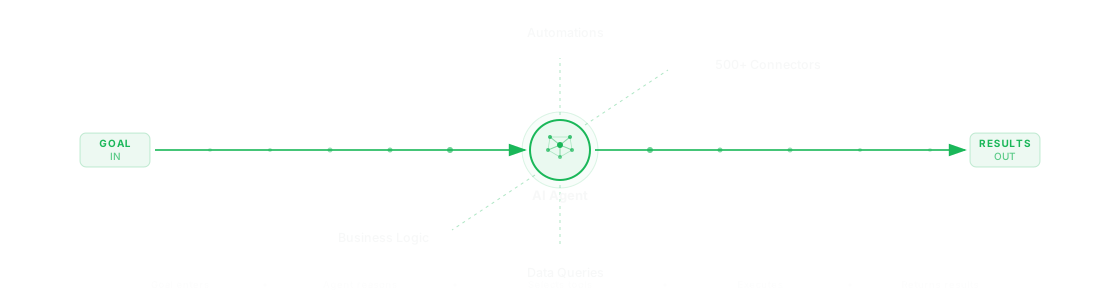
Define what the agent should accomplish and which tools it can use. The agent figures out the steps, executes them, and handles edge cases autonomously.
Agents don't operate in a vacuum. They have access to every connector on the APIANT platform (CRMs, ERPs, marketing tools, databases, custom APIs) all of them.
Not just single API calls. APIANT agents execute multi-step workflows autonomously: reading data, making decisions, writing back, triggering notifications, handling errors.
"Real data, real APIs, real business logic. Not sandboxed demos."
An APIANT AI Chatbot is deceptively simple in structure: a trigger (the user's message) and an action (the response). But between those two points lies the full power of the platform: AI, conditionals, data lookups, other automations, and any logic you can design.
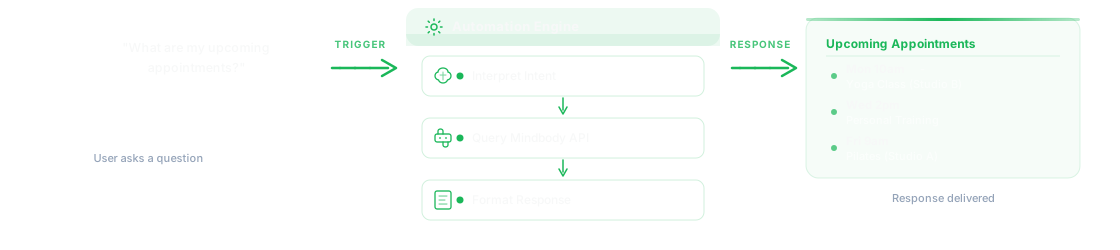
User sends a message to the chatbot
Response, API call, data write, notification, anything
"A chat is one trigger and one action. Everything between is up to your imagination."
A chatbot that looks up order status, checks inventory, creates tickets, and escalates to humans, all in one conversation flow.
Ask the chatbot to pull reports, update records, sync data across systems, or trigger workflows, via natural language.
Give your team a conversational interface to your entire tech stack. No dashboard hopping. Just ask and it acts.
See how an APIANT chatbot handles GDPR compliance requests across 5 systems in under two minutes.
MCP Servers provide a standardized protocol for AI models and agents to communicate directly with the APIANT platform. Instead of custom API wrappers, AI systems discover tools, understand schemas, and execute operations through a single consistent interface.
AI agents, chatbots, and LLM applications connect to 500+ integrations through MCP's open standard protocol.
The AI inside APIANT: production-ready, not bolted-on, not sandboxed. Want Claude Code operating the whole platform from your terminal? See AI Operability.
Most AI integration tools are wrappers: an LLM on top of a fixed set of API calls. APIANT's AI operates inside the full integration platform. The Co-Pilot writes connectors. Agents call 500+ prebuilt integrations, trigger automations, and execute multi-step workflows with full access to your business logic. It is AI as an operator of the platform, not a conversational layer in front of it.
APIANT is model-agnostic. The Co-Pilot and agents run on current frontier models by default, and MCP Servers expose your integrations as tools any compatible LLM can call (including models you host yourself). If compliance requires a specific model or deployment region, we work through that during onboarding.
The Co-Pilot reads the API docs, determines authentication, generates ingredients (individual operations), tests them against live endpoints, and self-corrects when something fails. A workflow architect still reviews the ingredients before wiring them into customer-facing automations, the same way you would review any new connector. The Co-Pilot removes the grunt work of reading docs and writing boilerplate, not the judgment of deciding what to deploy.
Agents operate with explicit goals and a scoped set of tools; they cannot call anything you have not exposed to them. You define guardrails at the automation layer (approval steps, conditional branches, rate caps, audit logging). Every agent action runs through the same execution engine as human-triggered automations, so everything is logged with full request and response bodies. You get the autonomy without the blast radius.
Only when you configure it to, and only the fields explicitly passed to the model. For the Co-Pilot's connector-building work, the input is API documentation and your own test data. For agents and chatbots, you control which fields are included in the model context. Enterprise deployments typically route model calls through your own cloud account or a private endpoint; we scope the data flow during procurement.
MCP (Model Context Protocol) is an open standard that lets AI models discover tools, understand their schemas, and invoke them through a consistent interface. APIANT's MCP servers expose your 500+ integrations as native tools that any MCP-compatible model can call. No custom function-calling glue, no bespoke wrappers. It is protocol-level interoperability between AI and your integration layer.
Yes. Agents, the chatbot layer, and MCP servers all work on top of your existing automations and connectors. Build the integration once in the Automation Editor, then let agents call it or expose it via MCP. The AI is an access layer, not a replacement for the integration work you have already done.
Your request will be posted to our Discord community, where independent builders who run their own APIANT-powered platforms can see it and reach out to you directly to build the integration.
← BackWe'll take a quick look to learn about your business.
Based on what we found, here are integration products that might be a great fit.
Your integration specialist is ready. Alex already knows your platform and what you're looking to build. Choose how you'd like to connect:
Voice call happens right in your browser. WhatsApp options open the app.
Prefer email? We'll follow up at within 2 hours.
Click the button below to start talking. Alex already has your details.
Your browser will ask for microphone access.
← BackExpect to hear from us within one business day.
Something went wrong. Please try again.