
Mindbody and Zoom: Run One Virtual Class Across Every Franchise Location
How ZoomConnect's cross-site class capability, centralized franchise management, and multiple Zoom account support unlock one instructor teaching across many sites.

The Franchise Virtual Class Problem
An 11-location virtual fitness franchise wants to run shared Zoom classes that any member, from any location, can book into. A popular instructor at one location should be able to teach a 6am virtual class that members from all 11 sites can attend together. Today, each location runs its own schedule and its own virtual classes, so the franchise ends up with duplicate classes, half-empty rooms, and instructor cost spread far too thin.
Consolidating would let the franchise run fewer, bigger virtual classes led by its strongest instructors. But the booking experience has to work cleanly for members at all 11 locations, or the franchise loses more in day-to-day chaos than it saves in instructor cost.
There is a second problem underneath it. Strong virtual instructors are scarce. If every location has to recruit its own, the smaller locations end up with weaker instructors, which drives down virtual attendance there, which makes those classes even harder to staff well. The smaller sites slide into a doom loop of mediocre virtual classes.

What the Per-Location Approach Actually Costs
When every location runs its own version of the same 6am class, you are paying instructors to teach near-empty rooms. A class of 14 costs the same to run as a class of 31, but it earns far less per seat and feels emptier to attend. Multiply that across 11 locations and three popular time slots and the waste is substantial.
The hidden cost is member experience. A member at a smaller location gets the so-so local instructor while a great instructor an hour away teaches to a thin crowd. Nobody is getting your best. And at headquarters, somebody is spending real time every week trying to coordinate 11 separate schedules and stitch together 11 separate sets of numbers that never quite line up.
How It Works With Shared Cross-Location Classes
ZoomConnect lets one virtual class accept bookings from multiple locations at once, even across time zones. The instructor sees a single class and a single roster. Each member sees the class through their own home location, books the way they always do, and gets their own personal join link.
What this gives the franchise:
- One strong instructor teaching one full class instead of several weaker ones teaching empty rooms.
- A central console at headquarters to manage shared classes, instructor assignments, and reporting in one place.
- The ability to run very popular classes without being capped, by spreading a large class across more than one Zoom account behind the scenes. The instructor still sees one room.
On pricing, you choose the model. Each location can charge its own regional price for the shared class, or every location can charge the same price for consistency. The system follows whichever you set and settles instructor pay accordingly.
Setting It Up
The setup at the franchise level looks like this:
- Connect all 11 locations to the franchise’s ZoomConnect subscription.
- Choose which class slots become shared. Most franchises pick their peak times, such as 6am, noon, and 7pm.
- Build the shared class once. It becomes bookable from every connected location.
- Members at any location see the class in their own schedule and book normally.
- The instructor gets one room, one roster, and one paycheck.
- Headquarters gets reporting that shows attendance by location, instructor revenue by class, and cross-location retention.
- Set the revenue-share rule once: the hosting location keeps it, revenue follows the member’s home location, or the franchise pools and redistributes. The system enforces whatever you pick.
- Keep instructor pay consistent between shared classes and local classes, so teaching a shared class is never a pay cut. That keeps your instructor pool stable.
A few practical cases are handled for you. Shared classes are scheduled in a single time zone and shown to each member at their local equivalent, so there are no duplicate classes to keep in sync. If the instructor calls out, the substitute takes over the shared class for every location’s bookings at once. And the reporting carries location detail, so headquarters can answer questions like “which locations’ members attend shared classes most” without merging 11 reports by hand.
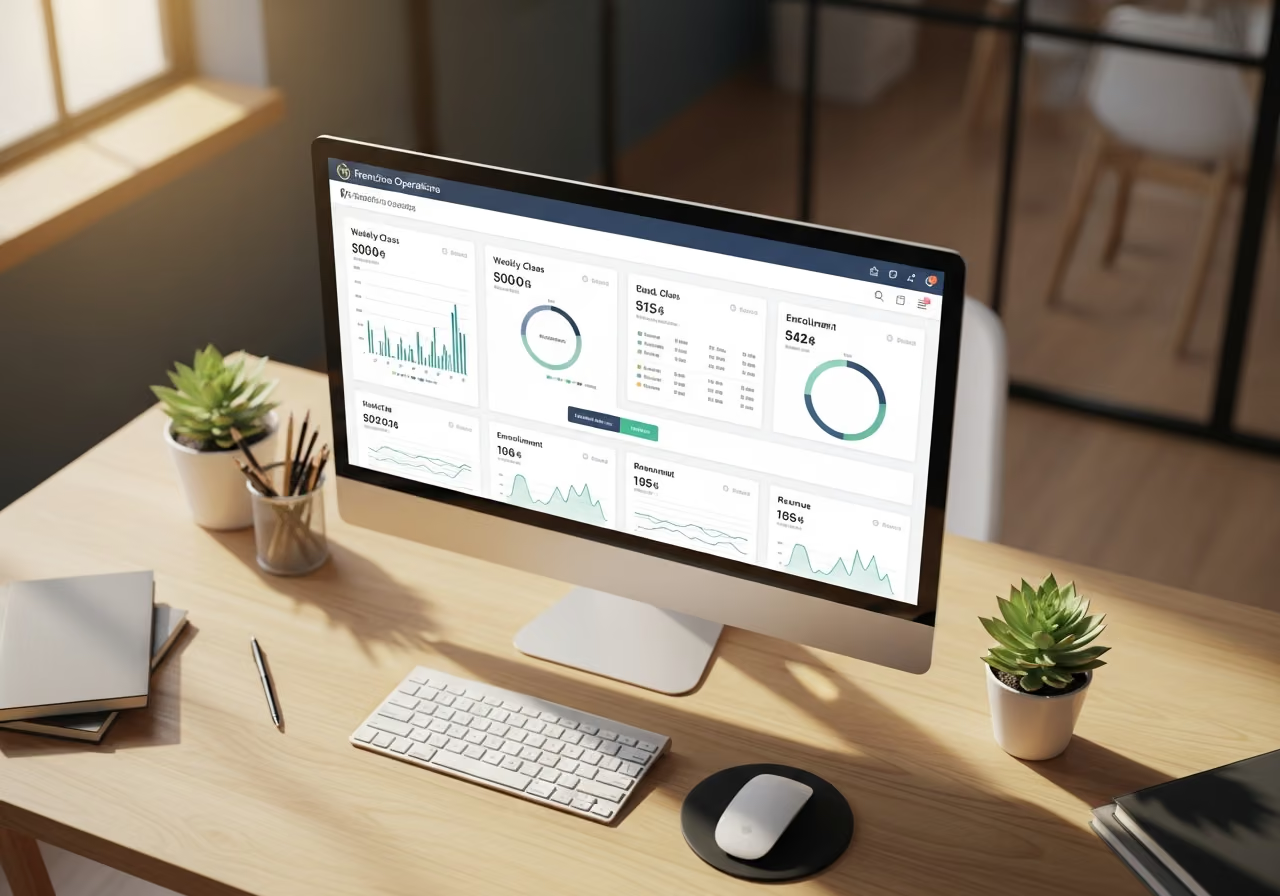
What the Numbers Could Look Like
Consider an illustrative example: a hypothetical 11-location virtual fitness franchise with around 7,800 members. After consolidating to shared virtual classes for its three peak slots:
- The franchise runs 18 classes a week instead of 33, cutting the old per-location duplication.
- Average class size rises from roughly 14 to roughly 31.
- Instructor cost per attended visit falls by around 40 percent.
- Headquarters time on schedule coordination drops from a near-full-time job to a weekly review meeting.
Retention improves because the virtual product itself gets better. A member who used to attend a so-so local instructor twice a week now attends a strong shared instructor four times a week. Her engagement deepens, her renewal becomes more likely, and the franchise’s virtual revenue compounds from a quality lift, not just a head-count lift. These figures are illustrative, not a real customer’s results.
Why This Matters for Your Franchise
- Per-location duplication is the wrong shape for virtual classes. Your members do not care which building a class is “based” in.
- Fewer, fuller classes with your best instructors raise quality everywhere, including at your smaller locations that could never recruit that talent alone.
- Central reporting is the second prize. The first is a virtual program members actually want to keep paying for.
Try It
Curious how this works across your locations? View the API App page.
Keep reading

The Gap Between "I Paid" and "I'm Booked"
A customer buys a class pack on Shopify, then can't figure out how to book it. Here's how a Mindbody booking widget and ShopConnect close that gap for good.

Mindbody and HighLevel: One Clear Schedule Per Student Across Every Program
If your studio runs beginner programs, longer courses, and private lessons at once, here is how your reminders finally match what each student actually has booked.

Mindbody and Klaviyo: Per-Location Marketing for a 6-Gym Strength Network
A central marketing team sending one blast to every member of a 6-gym network gets the coach name and the gym address wrong half the time.