
On APIANT, an MCP server is something you build: wrap any API in an automation, add whatever logic you need, and expose it over the Model Context Protocol. Your users and customers point their AI at it and call it like a tool. Web services, for AI.
The Model Context Protocol (MCP) is an open standard that lets AI applications call external tools. On APIANT, you build the MCP servers. Each one is an automation: it wraps any API, runs whatever logic you define, and is exposed over MCP as a tool any AI can call.
You decide the depth. An MCP server can be a thin pass-through to a single endpoint, or a multi-step automation that spans several systems, transforms data, enforces business rules, and returns a clean result. Build it once; your users and their AI agents consume it through one consistent protocol. (Looking instead for how Claude Code operates APIANT itself? That is AI Operability.)
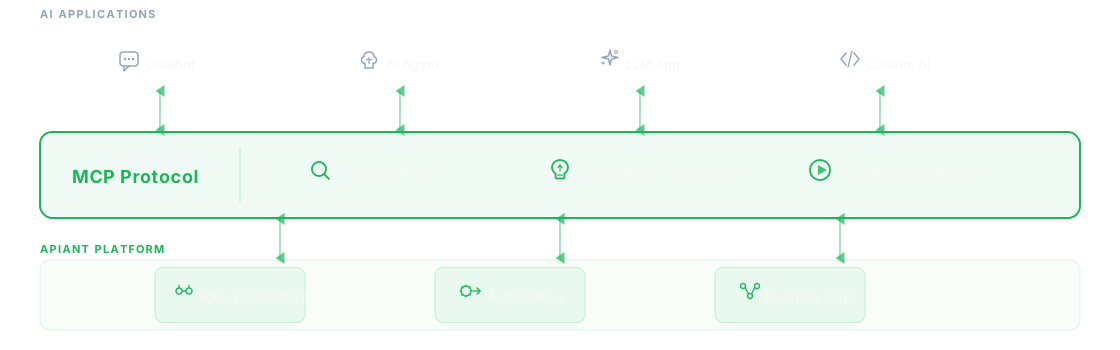
Here is an MCP server you built on APIANT, being called by one of your customers' AI agents. The agent discovers your tools, then executes one. Each tool is an automation you defined.
The AI agent never touches the underlying APIs. It calls your MCP tools, and the automations behind them handle the rest: authentication, rate limiting, error handling, multi-system logic, and data transformation.
Expose your product's capabilities as MCP tools, so your customers' AI agents can act inside your app on their behalf.
Give a customer's AI a single tool that pulls a unified view across their CRM, billing, and support systems.
One MCP tool backed by a multi-step automation that spans several APIs, applies your business logic, and returns a clean result.
Give your own AI agents safe, governed, rate-limited access to your stack, without writing a line of integration code.
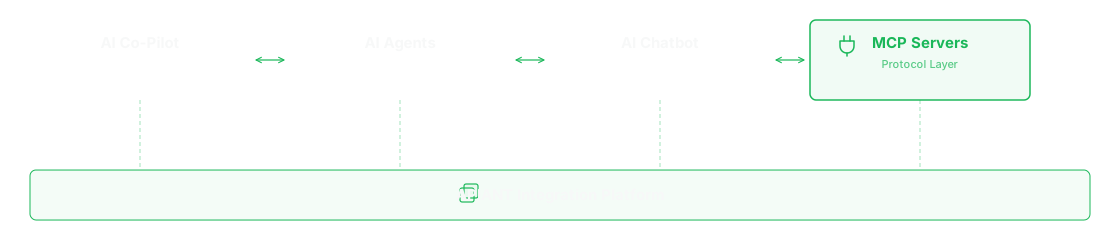
An MCP server you build is one capability among several. The Assembly Editor and AI Co-Pilot are how you build; AI Agents and the Chatbot are what you can run on top; Claude Code operates the whole platform. MCP servers are how you hand any of it to an outside AI.
Talk to us about the APIs you want to expose to AI.
Your request will be posted to our Discord community, where independent builders who run their own APIANT-powered platforms can see it and reach out to you directly to build the integration.
← BackWe'll take a quick look to learn about your business.
Based on what we found, here are integration products that might be a great fit.
Your integration specialist is ready. Alex already knows your platform and what you're looking to build. Choose how you'd like to connect:
Voice call happens right in your browser. WhatsApp options open the app.
Prefer email? We'll follow up at within 2 hours.
Click the button below to start talking. Alex already has your details.
Your browser will ask for microphone access.
← BackExpect to hear from us within one business day.
Something went wrong. Please try again.