
Enterprise IT teams are drowning in disconnected apps and shadow IT. APIANT gives you a dedicated integration platform your own AI agent operates: every connector, automation, and deployment built over a remote MCP server address and fully visible, auditable, and reversible in the Admin Console. Deep enough for complex logic, secure enough for compliance.
SOC 2 is stated as framework alignment, not a third-party certification. Contact the APIANT team for current attestations and audit documentation.
Every department adopts new SaaS tools. Every tool has an API. No one is connecting them deeply enough to trust the data flowing between them.
You have two bad options today: DIY tools like Zapier and Make that your teams cobble together without IT oversight, or enterprise iPaaS platforms like MuleSoft and Workato that demand specialized developers and six-figure contracts. Meanwhile, the deep integrations your business actually needs don't get built.
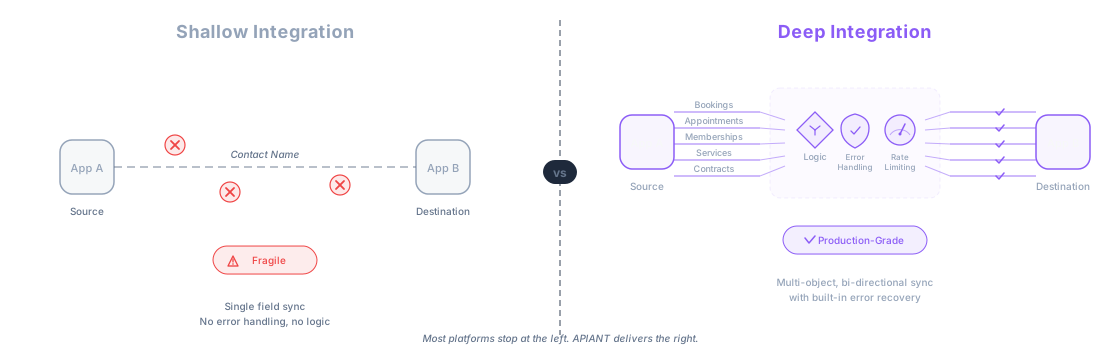
Your teams are building Zapier workflows and Make scenarios without IT's knowledge. No error handling. No monitoring. No compliance review. When one breaks at 2 AM and corrupts customer data, you find out from the customer, not from a dashboard.
Enterprise iPaaS platforms demand specialized developers, extensive training, and contracts that escalate with every connector and every transaction. You're paying enterprise prices for integrations that are still only medium-deep.
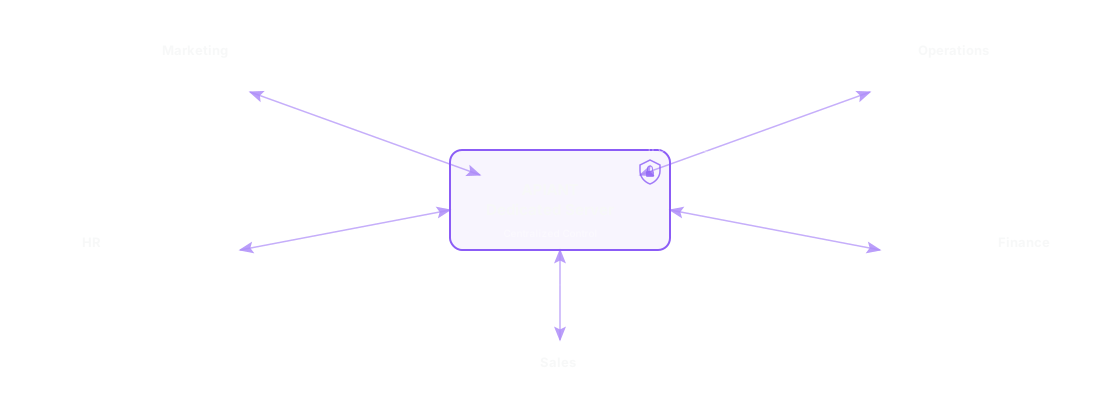
Marketing needs CRM integrations. Operations needs ERP connections. HR needs HRIS syncs. Finance needs billing reconciliation. Each department fights for engineering resources that never come, or builds fragile workarounds that IT can't support.
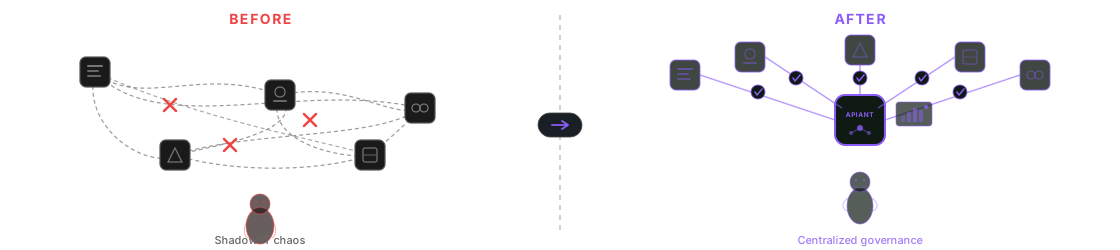
A fitness franchise with 232 locations needs booking data, membership changes, and purchase history synced to a single HubSpot instance with custom objects, bi-directional updates, and rate limiting. A shallow integration creates 232 disconnected data streams. A deep integration understands that when a client cancels Tuesday's class, their "next scheduled visit" refreshes across the entire system. That's the difference between data you can act on and data that misleads you.
APIANT gives your enterprise a dedicated integration server: fully managed infrastructure, your own environment, complete visibility. Build, deploy, and monitor deep integrations across every department without writing code.
We provision your dedicated APIANT server. Isolated environment, your domain, your security policies.
Use the AI Co-Pilot to build connectors for any API in your stack. It reads the docs, figures out auth, builds and tests the connector autonomously.
Build deep integrations with real business logic (conditional routing, data transformation, error handling, retry logic) using visual tools, not code.
Monitor every API call in real time. Control access by team and role. Deploy upgrades across all integrations simultaneously from the Admin Console.
The people building integrations on APIANT need domain expertise, not engineering skills. We call them workflow architects. They build visually, use the AI Co-Pilot for new API connections, and the platform handles rate limiting, error handling, retry logic, monitoring, and scaling.
In every enterprise we've spoken with, this person already exists in IT operations, solutions engineering, or business systems.
Every Zapier zap and Make scenario your teams built without IT oversight is a liability. APIANT gives you a single platform to consolidate, replace, and properly govern those integrations, with execution history, error monitoring, access controls, and audit trails. Your teams get the same speed they had with DIY tools. IT gets the visibility and control they need.
We don't just sell the platform. We run 17 integration products on it ourselves, serving thousands of businesses across health & wellness, healthcare, and nonprofit sectors. These are the numbers behind a production-grade enterprise integration platform.
A fitness franchise needed to unify 232 MindBody locations into a single HubSpot instance: every client's home location, secondary visits, frequency, membership status, and upcoming appointments in one place.
The integration manages 5 custom object types, 120+ fields per contact, bi-directional sync, and rate limiting at 185 API calls per 10 seconds. One codebase, 232 locations, each with its own feature toggles and business rules. Upgrades deploy simultaneously to all.
Zero errors. Zero rate limit violations. The integration team aren't engineers.
| Capability | APIANT (Dedicated Server) | Enterprise iPaaS (MuleSoft, Workato) | DIY Tools (Zapier, Make) |
|---|---|---|---|
| Operated by your AI agent | Yes: builds, deploys, and monitors end-to-end, every action auditable | No | No |
| Integration depth | Deep: real logic, error handling, custom objects, industry-specific rules | Deep, but requires specialized developers and months of development | Shallow: pre-built connectors, limited customization, no complex logic |
| Time to first integration | Days to weeks | Months | Hours (but shallow and fragile) |
| New API connector | AI Co-Pilot builds it overnight, ready for review | Manual SDK development (weeks to months) | Only if pre-built connector exists |
| Who builds | Workflow architect (non-developer with domain expertise) | Specialized iPaaS developers | Anyone, which is the problem |
| IT governance | Full: execution history, role-based access, audit trails, monitoring dashboard | Full, but complex administration | Minimal: no centralized visibility or control |
| Data integrity | Built-in error handling, retry logic, data validation, rate limiting | Depends on developer implementation | Compromised: inadequate safeguards for critical business data |
| Multi-location / multi-department | Native: master routing, shared connections, per-unit settings, rate limiting | Possible but complex custom engineering | Not designed for this |
| Scalability | One codebase, unlimited deployments, settings separated from logic | Each integration is often a custom build | Each workflow is independent, no reuse |
| Cost at scale | Predictable: dedicated server pricing | Escalates rapidly: per-connector, per-transaction, per-developer seat | Cheap per workflow, but costs multiply and quality suffers |
| Infrastructure | Dedicated server: managed by APIANT, owned by you | Vendor-managed multi-tenant platform | Vendor-managed shared infrastructure |
| AI capabilities | AI Co-Pilot, AI Agents with goals and tools, AI Chatbot | Emerging: varies by vendor | Basic AI features, no deep integration access |
Point your AI client at your server's MCP address (one address, nothing to install) and the agent operates the platform directly: it builds connectors, composes automations, runs tests, deploys, and monitors. Any client that takes a remote MCP server works, Claude Code, Codex and Cursor included. Every action runs as a discrete MCP tool call, so what the AI did is visible and auditable, and writes to production gate on explicit confirmation. Work that took weeks of engineering now ships in a morning, ready for your team to review.
We believe we're the first integration platform in the world with this capability.
While others bolt AI onto standalone chatbots, APIANT agents operate inside the full integration platform, with access to 500+ connectors, your automations, and your business logic. They don't just answer questions. They analyze data, make decisions, and take action through your APIs, with human oversight and guardrails for compliance.
An AI agent monitoring your CRM can detect when a high-value client's engagement pattern changes, cross-reference their recent support tickets, check their upcoming renewal date, and proactively alert the account team with a recommended action plan, all without anyone asking it to.
Centralized control over users, automations, connections, and deployments. Role-based access controls. System monitoring and usage analytics. Manage hundreds of accounts from a single dashboard.
Route incoming data to the right department, location, or business unit automatically. One webhook endpoint handles routing logic for your entire organization, no per-unit configuration needed.
Share API connections across teams and departments with granular controls. Mark connections as shared or private. Manage credentials centrally without exposing them to individual users.
Intelligent rate limiting across all automations hitting the same API. When 50 departments share a single Salesforce instance, the platform ensures you never exceed API limits, automatically throttling and queuing requests.
Upgrade integration logic across every department simultaneously. Test changes on one unit, then deploy to all. Version comparison shows exactly what changed between deployments.
Every API call logged. Every error surfaced. Execution history with full request/response detail for debugging. Proactive alerts before issues impact business operations.
APIANT builds your first integrations. You validate the results. Expand when ready.
Your team owns the platform. We handle infrastructure and training.
APIANT started as a system integrator. We built integration products for clients, realized we needed a better platform, and built our own. Today we run 17 integration products on the same platform we're offering you, serving thousands of businesses with sub-1% churn. We didn't build a platform and go looking for users. We were the users first.
Your data never touches shared infrastructure. Every APIANT deployment runs on a dedicated, isolated server under your control.
Your own server instance. No shared tenancy, no noisy neighbors, no data commingling. Your integrations run in complete isolation.
Full audit trails, role-based access control, and API key management. Monitor who accesses what, when, and from where.
HTTPS everywhere, encrypted credentials, secure webhook endpoints, and configurable data retention policies to meet your regulatory requirements.
Need specific compliance documentation? Talk to our team about your requirements.
Whether you need APIANT to build and manage your integrations or you want your team to own the platform, we'll help you figure out the right approach for your enterprise.
Every APIANT deployment runs on a dedicated, isolated server under your control. No shared tenancy. No data commingling with other customers' workloads. Credentials are encrypted at rest, webhook endpoints are HTTPS-only, and role-based access control in the Admin Console governs who sees what. Specific compliance documentation (SOC 2, HIPAA, GDPR) is available on request from our team.
Many enterprises run APIANT alongside a heavyweight iPaaS for specific workloads where that tool is too slow, too expensive, or too shallow. APIANT shines on customer-facing integrations, multi-location deployments, and verticals the big platforms do not cover well. The AI Co-Pilot lets you build a new connector in hours instead of weeks, which is the common reason teams bring us in even when they have an incumbent platform.
Enterprise customers get a contractual SLA covering uptime, response time, and escalation procedures; specific numbers and credits are negotiated per agreement. Because every deployment is dedicated infrastructure on AWS, uptime is not dragged down by other customers' workloads. Ask our team for the current SLA template and operational history during procurement.
Yes, through secured endpoints, VPN, or private link configurations depending on your environment. Dedicated deployments give you control over network rules, IP allowlists, and credential handling. For SAP, Oracle, legacy ERPs, or internal microservices, we scope the network topology during the pilot phase.
The Admin Console gives centralized control over users, automations, connections, and deployments with role-based access. Bulk deployment lets you test a change on one unit, then push it to every department simultaneously; version comparison shows exactly what changed. Master routing directs incoming data to the right business unit automatically, so adding a new department does not require building a new endpoint.
Under the Managed Pilot, APIANT scopes, builds, and deploys your highest-priority integrations on your dedicated server within weeks. Your IT team gets full visibility through the Admin Console, monitoring dashboards, and execution logs, without carrying the build burden. Support, monitoring, and upgrades are handled by us during the pilot. If the results validate the platform, your team takes ownership of new integrations from there.
You own your data, your credentials, and your connection configurations. Integration logic lives in the Automation Editor as visual recipes; export and documentation are available so your team can rebuild elsewhere if needed. Dedicated deployments mean there is no shared vendor lock at the data layer. Contract terms cover data portability and transition assistance explicitly; we can share the standard enterprise agreement during evaluation.
Every action the agent takes runs as a discrete MCP tool call against your dedicated server, and the Admin Console logs it with full execution history. Permissions are scoped: you control which environments and operations the agent can reach, and writes to production gate on explicit confirmation. Anything the agent builds or changes is visible, attributable, and reversible, and your team reviews automations before they go live. The AI accelerates the work; your governance controls stay in place.
Your request will be posted to our Discord community, where independent builders who run their own APIANT-powered platforms can see it and reach out to you directly to build the integration.
← BackWe'll take a quick look to learn about your business.
Based on what we found, here are integration products that might be a great fit.
Your integration specialist is ready. Alex already knows your platform and what you're looking to build. Choose how you'd like to connect:
Voice call happens right in your browser. WhatsApp options open the app.
Prefer email? We'll follow up at within 2 hours.
Click the button below to start talking. Alex already has your details.
Your browser will ask for microphone access.
← BackExpect to hear from us within one business day.
Something went wrong. Please try again.