
Point your AI agent at any API your customers need. It builds the connector, composes the automation, tests against live endpoints, and ships to production, on a dedicated APIANT server white-labeled as your own. Any AI client works, Claude Code, Codex and Cursor included: one remote MCP server address, nothing to install. Your engineering team stays on your product.
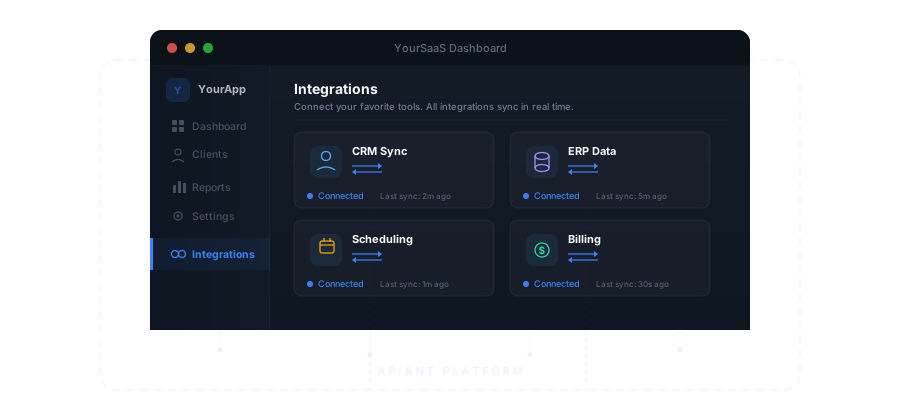
Your franchise sales team needs a Mindbody integration to close a six-figure deal. Your customers are churning because the Salesforce sync is shallow. Every year, AI features and core product win the resource fight. Integration gets pushed to next quarter. Meanwhile, your competitors are shipping integrations.
Your best engineers should be building your product, not maintaining API connections. But integration requires deep technical work, and you can't just hand it to a junior dev.
Your customers don't need "sync a contact." They need 120+ custom fields, bi-directional sync, custom objects, class bookings, memberships, rate-limited multi-location support. They need deep.
Third-party embedded iPaaS platforms own the infrastructure, the data flow, and the customer experience. You're renting capacity on their multi-tenant system. Your brand disappears.
A yoga studio member books Saturday morning yoga for the rest of the year. A shallow integration creates 52 records and calls it done. A deep integration understands that when the member attends Saturday's class, the "next scheduled visit" refreshes to next Saturday. When they cancel, it refreshes again. Getting that right is the difference between marketing automation that works and marketing automation that embarrasses you.
APIANT gives you a dedicated integration platform: your own servers, your own brand, fully managed by us. Your AI agent operates it over a remote MCP server address, building connectors, composing automations, testing, and deploying, or a workflow architect runs the visual editors. Either way, your engineering team stays focused on your product.

We spin up your dedicated APIANT server. Your brand, your domain.
Use the Assembly Editor + AI Co-Pilot to create connectors for any API. Use the Automation Editor to build deep integrations with real business logic.
Wrap integrations in FormApps for seamless in-product installation. Your customers configure integrations without ever leaving your product.
One codebase serves all your customers. Different settings, same logic. Deploy upgrades to everyone simultaneously.
The person building integrations on APIANT needs domain expertise, not engineering skills. We call them workflow architects. They build visually, use the AI Co-Pilot for new API connections, and the platform handles rate limiting, error handling, retry logic, monitoring, and scaling.
Take health and wellness integrations. There are three things every fitness business absolutely needs to automate marketing: When did the customer last buy something? When did they last physically walk in? And when are they scheduled to come in next?
Getting that third one right means understanding that a class booking isn't the same as attendance, that cancellations change the answer, that a 10-pack purchase depletes over time and should trigger a replenishment campaign at the right moment. A developer can call an API. A workflow architect who understands the fitness industry knows which data actually matters and how it should drive automation. That's the difference between an integration that exists and one that closes deals.
With APIANT, you assign someone who understands the industry, not someone you're pulling off your product roadmap. They build deeper, faster, and keep iterating, because integration is their job, not their side project.
| Capability |  Dedicated APIANT Server Dedicated APIANT Server |
 Embedded iPaaS Embedded iPaaS |
 Build In-House Build In-House |
|---|---|---|---|
| Operated by your AI agent | Yes: builds, tests, deploys, and monitors end-to-end | No | No |
| Integration depth | Deep: real logic, error handling, custom objects, industry-specific rules | Shallow to medium: pre-built connectors, limited customization | Deep (but painfully slow) |
| Time to first integration | Days to weeks | Weeks to months | Months |
| New API connector creation | AI Co-Pilot builds it, ready for review | Manual SDK development or request from vendor | Full engineering effort |
| White-label | Complete: your brand, your domain, your UX | Partial: vendor UI often leaks through | N/A |
| Ownership | You own the server and the customer relationship | You rent capacity on their multi-tenant platform | You own code but also own all maintenance |
| Data processing | Unified engine: any format, no payload limits | Varies: often hits limits with large/complex payloads | Depends on your implementation |
| Multi-location / franchise | Native: shared connections, rate limiting, master routing | Limited or manual | Complex custom engineering |
| Who builds | Your AI agent, or a workflow architect (non-developer) | Varies: often requires engineering | Your engineering team |
| Who maintains | APIANT manages servers, you manage integrations | Vendor manages platform | Your engineering team |
| Cost at scale | Predictable: dedicated server pricing | Escalates with volume and connectors | Headcount-dependent |
A SaaS company's franchise sales team needs deep Mindbody integrations to close six-figure headquarter deals. Their internal team built a basic integration (four inbound events, limited sync) but priorities shifted to AI features. The integration is now static.
With a Dedicated APIANT Server, that same company gets 120+ synced fields, bi-directional sync, five custom object types, multi-location support with shared connections and rate limiting, and real-time monitoring. One codebase works for a single yoga studio or a 232-location franchise.
The integration team doesn't need to be engineers. They need to understand the fitness and wellness industry. The platform handles the rest.
Based on a real SaaS company conversation. The reaction from their DevRel lead: "How do we make this happen?"
Your partnership team just landed a deal that requires integration with an app you've never touched. Normally, that's weeks of API documentation reading, SDK work, and engineering time.
With the APIANT Co-Pilot, your workflow architect types the app name. The AI finds the documentation, determines authentication, builds the connectors, tests them against live APIs, and self-corrects if anything fails. By the next morning, you have production-ready building blocks, ready for your team to review and ship.
We believe we're the first integration platform in the world with this capability.
This isn't a new hire. In every SaaS organization we've spoken with, someone already exists who fits this role, often in partnerships, customer success, or solutions engineering. They understand the industry, they understand the customer workflows, and they have enough technical comfort to work with visual tools.
When one SaaS company saw our platform, their partnerships lead immediately identified two existing team members (co-founders of an acquired integration product) as perfect fits. The technical acumen required is understanding business logic, not writing code.
Whether you want APIANT to build and manage your integrations or you want to own the platform yourself, we'll help you figure out the right approach.
Embedded iPaaS vendors own the multi-tenant infrastructure, the connectors, and often the customer UX. You rent capacity. When you outgrow their integration depth (custom objects, industry-specific logic, rate-limited multi-location support), you have no path to extend it without their roadmap. APIANT gives you a dedicated server branded as yours, with full control over logic, UI, and pricing to your customers. The workflow architect on your side owns the product.
It is complete white-label. Your server runs on your subdomain. FormApps embed inside your product with your styling, so the end user never leaves your app to configure an integration. There is no vendor logo in the setup flow, no third-party billing page, and no redirect to a partner portal. Your customers see your product.
Deep means bi-directional sync with custom objects, not one-way contact pushes. It means understanding that a Mindbody class booking is not the same as attendance, that a 10-pack purchase depletes over time and should trigger replenishment campaigns, that family members sharing an email need to roll up to a single company record in HubSpot. Shallow connectors move records. Deep integrations encode the business logic that makes the data actually useful.
For an API already covered by a prebuilt connector, days to a couple of weeks from the first build session. For an API we have never touched, the AI Co-Pilot typically produces production-ready ingredients overnight, and the workflow architect wraps them in the Automation Editor within days. Compare that to months of engineering time in-house.
You move up. Sandbox is for evaluation, Pro ($499/mo) suits most SaaS companies with a single production server and 10 connections, Scale ($1,500/mo) is the sweet spot for production workloads with 50 connections, and Enterprise (from $3,500/mo) adds dedicated AWS infrastructure with an SLA. Tiers are about headroom, not feature gating: the editors, AI Co-Pilot, and connector catalog are available at every level.
In Path 1 (APIANT builds and manages), your customers subscribe directly to APIANT and you refer. In Path 2 (you own the platform), you own the billing, the pricing, and the customer. Many SaaS companies start on Path 1 to ship fast and migrate to Path 2 once integrations become a strategic revenue line.
The settings-vs-logic architecture separates what is universal from what is unique. Logic (data flow, error handling, object mapping) is the same for every deployment. Settings (which fields to sync, which features to enable) differ per customer. When you push a logic upgrade, every customer inherits it simultaneously without touching their configuration. No per-tenant migrations, no long-tail breakage.
Your AI agent builds the integration; APIANT runs it. Connector logic and automations execute on APIANT's deterministic execution engine, with error handling, retry logic, rate limiting, and monitoring enforced at the platform layer. The agent tests against live APIs before anything ships, and your team reviews the result before it reaches customers. The AI is the builder; the platform is the guarantor.
Your request will be posted to our Discord community, where independent builders who run their own APIANT-powered platforms can see it and reach out to you directly to build the integration.
← BackWe'll take a quick look to learn about your business.
Based on what we found, here are integration products that might be a great fit.
Your integration specialist is ready. Alex already knows your platform and what you're looking to build. Choose how you'd like to connect:
Voice call happens right in your browser. WhatsApp options open the app.
Prefer email? We'll follow up at within 2 hours.
Click the button below to start talking. Alex already has your details.
Your browser will ask for microphone access.
← BackExpect to hear from us within one business day.
Something went wrong. Please try again.