
You solve integration problems every day. With APIANT, you can productize those solutions: build once, sell to many, and grow a scalable recurring revenue stream.
It gets bigger. Claude Code makes integration engineering faster. It does not replace the System Integrator who understands the client's business, owns the relationship, and packages integrations as a product. Domain expertise is still the moat. Claude Code is your leverage: it builds the connectors overnight so you can productize verticals no one else serves.
The integration market is massive and fragmented. Enterprises and SaaS companies are desperate for deep, reliable integrations, not the shallow connectors Zapier and Make provide.
You already know how to solve these problems. You've done it dozens of times for individual clients. What you don't have is a platform to productize, distribute, and monetize those solutions at scale.
APIANT gives you that platform.
Every company needs integrations. Most iPaaS platforms deliver shallow connectors that break under real-world complexity. Deep integration expertise is scarce, and that's exactly what you have.
You've spent years learning specific verticals, understanding business rules, and building custom solutions. That domain knowledge is the hardest thing to replicate, and the most valuable thing you can productize.
Custom integration projects end. Products don't. Every customer you add compounds your revenue without proportionally increasing your effort. Build once, collect monthly. Forever.
Every step feeds the next. The more you build, the more you earn. The more you earn, the more you can build.
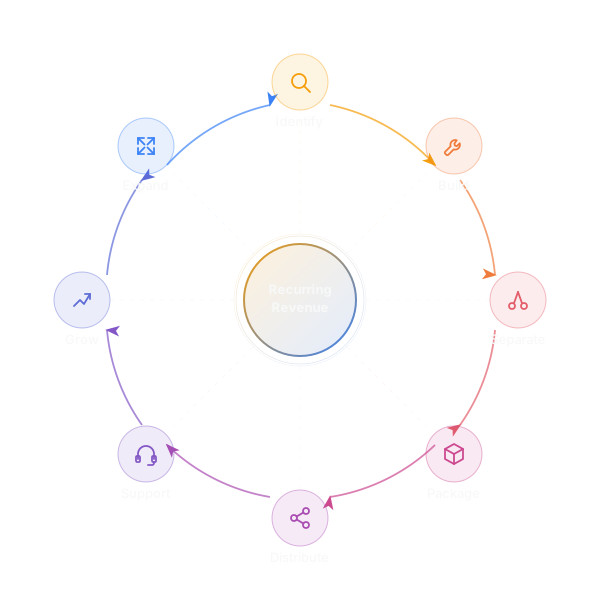
Pick a vertical or integration problem you know deeply from years of client work.
Create the solution using APIANT's Assembly Editor and AI Co-Pilot.
Isolate settings from logic so one codebase serves many customers.
Wrap it as an API App with FormApps for easy end-user installation.
Sell through your own channels, under your own brand and pricing.
Built-in monitoring lets you answer customer questions in seconds, not hours.
Every new customer adds recurring revenue with minimal marginal effort.
Use the platform to add more integration products and enter new verticals.
The difference between custom integration work and a product is simple: separation of settings from logic.
Each customer consumes the integration differently, but they all run the same battle-tested logic. When you upgrade the logic, every customer gets the update simultaneously. That's the difference between a consulting engagement and a product.
This isn't a reseller program. You get your own platform.
Your company name, your domain, your logo. Customers never see APIANT. They see you.
Set your own subscription tiers, pricing models, and packaging. You control the business model entirely.
You own every customer relationship. Direct billing, direct support, direct communication. No intermediary.
Manage users, monitor automations, control deployments, and oversee everything from a single dashboard. You can even shut it down.
APIANT manages the servers, the uptime, the scaling, and the platform updates. You focus on what you're best at: building integrations and serving customers. We handle everything else.
With a Dedicated APIANT Server, you're not just an SI anymore. You're an integration platform.
Target specific verticals where you have domain expertise, because domain expertise is the most important ingredient in building deep integrations. Understanding when a yoga studio owner needs to know their client's next scheduled visit matters more than knowing how to parse JSON.
Solve specific problems better than anyone because you've been solving them for years. Now do it at scale.
Pick the industry you know best: fitness, real estate, veterinary, nonprofit, franchise operations. Build integrations so deep that no generic iPaaS can compete.
Every vertical has specialized software that the big platforms ignore. Veterinary management systems, donor platforms, franchise scheduling tools. Too niche for Workato. Perfect for you.
You have relationships and credibility in your vertical. Customers trust an integration built by someone who understands their industry over a generic connector from a platform that's never seen their workflow.
Build one integration product. Price it at $99/month. Watch what happens.
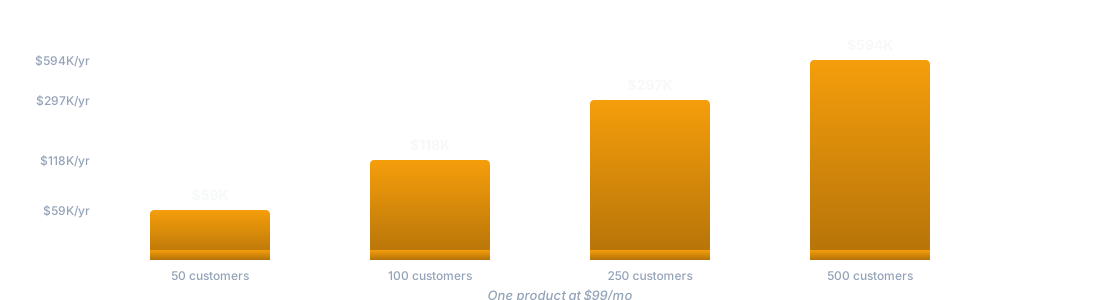
The platform scales. The logic is shared. Customer 500 costs you almost nothing more than customer 1. Every new subscriber is nearly pure margin. That's the power of productization over custom project work.
Your APIANT platform cost is fixed regardless of how many customers you serve. As your subscriber count grows, your per-customer cost shrinks and your margins expand. Talk to us about platform pricing for your scenario.
See how your margins improve as you grow your customer base.
Your client needs integration with an app you have never worked with? Point Claude Code at the API. It reads the docs, builds the connector, composes the automation, tests against live endpoints, and ships to production, operating APIANT end-to-end through the plugin. Let it run overnight; wake up to a new product.
Every vertical has niche software the big iPaaS platforms ignore: veterinary management systems, donor platforms, franchise scheduling tools. With Claude Code, you can build connectors for any of them in hours, not months. That's how you own a vertical nobody else can serve.
This is how you expand your product catalog without expanding your team.
APIANT started as an SI. We built integration products for clients, realized we needed a better platform, and built our own.
Today we run 17 integration products on the same platform we're offering you, and we operate it with Claude Code: the same plugin and skills you would use, building and maintaining our own products end-to-end. Every feature, every capability, we use daily.
We didn't build a platform and go looking for users. We were the users first.
Whether you're a solo consultant or a growing SI, the path from custom projects to recurring revenue starts with a conversation.
Custom project work caps your revenue at the billable hours of your team. Productizing on APIANT flips the model: build an integration once, sell it as a recurring SaaS product, and every new customer is nearly pure margin. Platform cost is fixed, the logic is shared, and customer 500 costs you almost nothing more than customer 1. That is the difference between a consultancy and an integration business.
Your dedicated APIANT server runs on your subdomain with your branding. FormApps embed in your product or portal with your colors and copy. There is no APIANT logo in the customer flow, no redirect to a third-party billing page, and no vendor attribution in the setup UX. Your clients know you, not us.
Point the AI Co-Pilot at the API. It reads the documentation, determines authentication, builds the ingredients, tests them against live endpoints, and self-corrects. By the next morning your workflow architect has production-ready building blocks to wrap in an Automation. That is how you expand into verticals the big iPaaS platforms ignore (veterinary, donor management, niche franchise tools) without adding headcount.
Both models exist. Most SIs run their own SKU: you sell an integration product at the price your market will pay, your clients pay you, and you pay APIANT for the platform. Your margins scale with your subscriber count. If you prefer to refer clients directly to APIANT, that works too. Talk to us about the pricing setup for your scenario.
It depends on transaction volume per customer, not raw count. A typical Pro deployment ($499/mo, 10 connections) comfortably supports dozens of customers on light-to-moderate workloads. Scale ($1,500/mo, 50 connections) is sized for production workloads at larger customer counts. When rate limits or throughput become the ceiling, you either move up a tier or split into multiple dedicated servers. We size it with you based on real traffic patterns.
APIANT manages the platform (servers, uptime, platform updates). You manage the integrations on top. Every automation has searchable execution history with full request and response bodies, so your support team can diagnose in minutes instead of hours. Enterprise tiers include a contractual SLA and priority escalation to APIANT engineering; details on request.
You rebuild in the Automation Editor because the platform handles rate limiting, retries, error handling, monitoring, and multi-location routing for you (features you likely wrote from scratch in your existing code). The Assembly Editor plus AI Co-Pilot dramatically compresses the rebuild time, and the resulting product is something you can sell to every other client in the same vertical. The migration conversation usually happens during the first scoping call.
Claude Code is the builder. It still needs a platform to build on and a business to sell the result. APIANT is the platform: the dedicated server, the deterministic execution engine, the white-label layer, the Admin Console. You are the business: you understand the vertical, you own the client relationship, and you package the integration as a product and price it. Claude Code compresses the engineering. It does not understand your client's business or carry your brand. That is still you.
Your request will be posted to our Discord community, where independent builders who run their own APIANT-powered platforms can see it and reach out to you directly to build the integration.
← BackWe'll take a quick look to learn about your business.
Based on what we found, here are integration products that might be a great fit.
Your integration specialist is ready. Alex already knows your platform and what you're looking to build. Choose how you'd like to connect:
Voice call happens right in your browser. WhatsApp options open the app.
Prefer email? We'll follow up at within 2 hours.
Click the button below to start talking. Alex already has your details.
Your browser will ask for microphone access.
← BackExpect to hear from us within one business day.
Something went wrong. Please try again.